


Product Introduction
|
Product Name |
Cat. No. |
Spec. |
|
Universal DNA Purification and Gel Extraction Kit |
G3631-100T |
100 T |
Product Description/Introduction
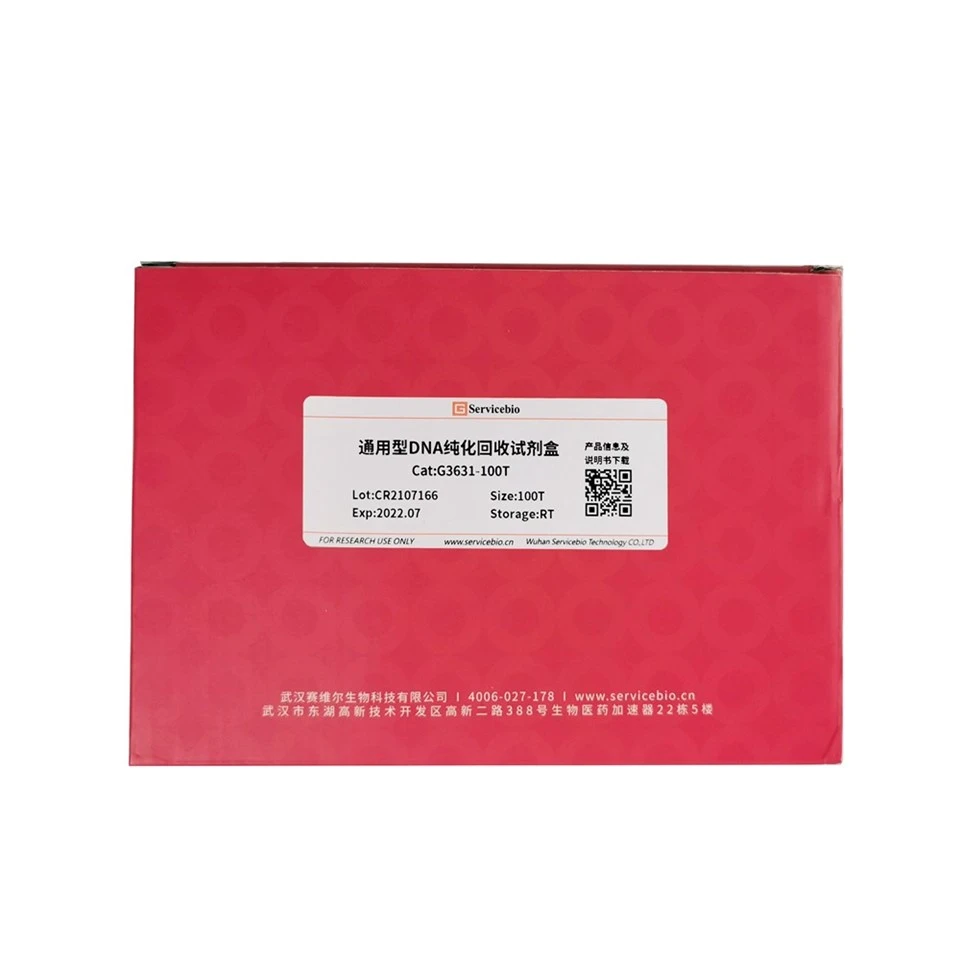
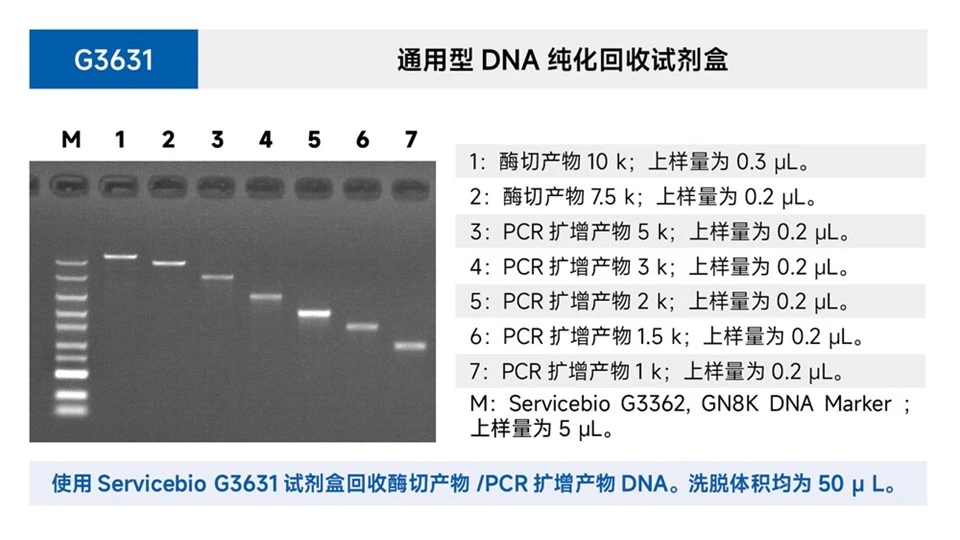
Universal DNA Purification and Gel Extraction Kit uses a unique Bind DNA Mini Column, which can be used to recover DNA fragments from TAE or TBE agarose gels as well as for direct purification of PCR products to meet a variety of experimental needs. The Buffer GL contains pH indicator, which can judge whether the gel solution or PCR product recovery has reached the optimal state according to the solution color. DNA fragments of 100 bp-10 kb can be recovered with a recovery rate of 85%. The DNA binding capacity of each column is up to 20 μg. DNA recovered using this kit is suitable for a variety of routine operations, including enzyme digestion, PCR, sequencing, library screening, ligation and transformation experiments.
Storage and Shipping Conditions
Ship and store at room temperature, valid for 12 months.
Product Contents
|
Component Number |
Component |
G3631-100T |
|
G3631-1 |
Buffer BL |
50 mL |
|
G3631-2 |
Buffer GL (Yellow) |
60 mL |
|
G3631-3 |
Buffer PW |
2×15 mL (60 mL of anhydrous ethanol added before use) |
|
G3631-4 |
Elution Buffer |
15 mL |
|
G3631-5 |
Bind DNA Mini Columns |
100 |
|
G3631-6 |
Collection Tubes |
100 |
|
Manual |
One copy |
|
Assay Protocol / Procedures
DNA extraction from agarose gels
1. Column Equilibrium: Place the Bind DNA Mini Columns into the collection tubes, then add 500 μL of solution Buffer BL into the Bind DNA Mini Columns, centrifuge at 10,000 g for 1 min, remove the waste liquid in the collection tubes, and put the Bind DNA Mini Columns back into the collection tubes (please use columns processed on the same day).
2. Single-purpose DNA bands are cut from the agarose gel with a clean blade (remove as much excess as possible) into clean centrifuge tubes, weigh.
3. Add an equal volume of Buffer GL to the gel block (if the gel weighs 0.1 g and its volume can be regarded as 100 µL, then add 100 µL of Buffer GL) and water bath at 60°C until the gel block is completely dissolved (during this time, keep gently turning the centrifuge tube up and down to make sure that the gel block is sufficiently dissolved, and if the volume of the gel block is too large, cut the gel block into small pieces beforehand) (Note: For high recovery yield, 1/2 gel volume of isopropanol can be added after adding Buffer GL to completely dissolve the gel to increase the recovery rate; it is best to lower the solution temperature to room temperature after the gel is completely dissolved before loading the column because the column has a stronger ability to bind DNA at room temperature. The gel should appear light yellow after complete melting and can be used for subsequent operations. If the color of the solution is purple or red after the gel has completely melted, use 10 µL of 3M sodium acetate (pH 5.0) to change the color of the solution to a pale yellow before proceeding).
4. Transfer all the solution obtained in the previous step into the column (adsorption column in the collection tube), centrifuge at 10,000 g for 1 min, discard the waste liquid in the collection tube, and put the column into the collection tube (Note: the volume of the column is 800 μL, if the volume of the sample is larger than 800 μL, it can be added in batches).
5. Add 700 μL of Buffer PW to the column (check that anhydrous ethanol has been added before use), centrifuge at 10,000 g for 1 min, discard the waste liquid from the collection tube, and place the column into a collection tube (Note: If the recovered DNA is to be used in salt-sensitive experiments, such as flat end ligation experiments or direct sequencing, it is recommended that Buffer PW be allowed to stand for 2-5 min before centrifugation)
6. Repeat step 5.
7. Place the column in a collection tube and centrifuge at 10,000 g for 2 min to remove as much residual liquid as possible. Leave the column at room temperature for 5 min and dry thoroughly (Note: ethanol residue in the rinsing solution will affect the subsequent enzyme digestion, PCR and other experiments)
8. Put the column into a clean centrifuge tube, leave it at room temperature for 5 min, dry it thoroughly (Note: the residue of ethanol in the rinsing solution will affect the subsequent enzyme digestion, PCR and other experiments), add 30~50 μL of Elution Buffer or ddH2O to the middle of the membrane overhanging the membrane (it is better to preheat the Elution Buffer or ddH2O at 60-65°C), and leave it at room temperature for 2 min, and then centrifuge at 10,000 g for 2 min. Leave the membrane at room temperature for 2 min, then centrifuge at 10,000 g for 2 min to collect the DNA solution. (Note: The volume of eluent should not be less than 30 μL, too little volume will affect the recovery efficiency. The pH value of the eluent has a great influence on the elution efficiency. If sequencing is to be done later, ddH2O should be used as the eluent and its pH should be within the range of 7.0-8.5. A pH lower than 7.0 will reduce the elution efficiency; and the DNA product should be stored at -20℃ to prevent DNA degradation. (In order to improve the recovery of DNA, the solution obtained by centrifugation can be refilled back into the centrifugal column, placed at room temperature for 2 min, centrifuged at 10,000 g for 2 min, and the DNA solution collected into the centrifuge tube).
(10) Recovery of DNA fragments from PCR reaction solution or digestion reaction solution
1. Column Equilibrium: Place the Bind DNA Mini Columns into the collection tubes, then add 500 μL of solution Buffer BL into the Bind DNA Mini Columns, centrifuge at 10,000 g for 1 min, remove the waste liquid in the collection tubes, and put the Bind DNA Mini Columns back into the collection tubes (please use columns processed on the same day).
2. Estimate the volume of PCR reaction solution or digestion reaction solution, add 3 times the volume of solution Buffer GL to it (add no less than 150 μL of Buffer GL), and mix well (no need to remove paraffin oil or mineral oil). (Note: For high recovery yields, isopropanol can be added 3/4 of the volume of the PCR or digestion solution after the addition of Buffer GL to increase the recovery rate; the solution should be light yellow after mixing before proceeding. If the color of the solution is purple or red after mixing, please use 10 µL of 3M sodium acetate (pH 5.0) to change the color of the solution to light yellow before proceeding).
3. Transfer all the solution obtained in the previous step into the Bind DNA Mini Column (Bind DNA Mini Columns in the collection tube), centrifuge at 10,000 g for 1 min, discard the waste liquid in the collection tube, and put the Bind DNA Mini Column into the collection tube (Note: the volume of the Bind DNA Mini Column is 800 μL, if the volume of the sample is larger than 800 μL, it can be added in batches).
4. Add 700 μL of solution Buffer PW to the Bind DNA Mini Column (check that anhydrous ethanol has been added before use), centrifuge at 10,000 g for 1 min, discard the waste liquid in the collection tube, and place the Bind DNA Mini Column into the collection tube (Note: If the recovered DNA is to be used for salt-sensitive experiments, such as flat-end ligation or direct sequencing, it is recommended that Buffer PW be allowed to stand for 2-5 min after addition before centrifugation).
5. Repeat step 4.
6. Place the column in a collection tube and centrifuge at 10,000 g for 2 min to remove as much residual liquid as possible.
7. Put the column into a clean centrifuge tube, leave it at room temperature for 5 min, dry it thoroughly (Note: the residue of ethanol in the rinsing solution will affect the subsequent enzyme digestion, PCR and other experiments), add 30~50 μL of Elution Buffer or ddH2O to the middle of the membrane overhanging the membrane (it is better to preheat the Elution Buffer or ddH2O at 60-65°C), and leave it at room temperature for 2 min, and then centrifuge at 10,000 g for 2 min. Leave the membrane at room temperature for 2 min, then centrifuge at 10,000 g for 2 min to collect the DNA solution. (Note: The volume of eluent should not be less than 30 μL, too little volume will affect the recovery efficiency. The pH value of the eluent has a great influence on the elution efficiency. If sequencing is to be done later, ddH2O should be used as the eluent and its pH should be within the range of 7.0-8.5. pH lower than 7.0 will reduce the elution efficiency; and the DNA products should be stored at -20℃ to prevent DNA degradation. (To increase the amount of DNA recovered, the solution obtained by centrifugation can be refilled back into the centrifugal column, left at room temperature for 2 min, centrifuged at 10,000 g for 2 min, and the DNA solution collected in a centrifuge tube).
Note
1. The addition of Buffer BL improves the adsorption capacity of the adsorption column and enhances the homogeneity and stability of the column, eliminating the effects of high temperatures/humidity or other undesirable environmental factors on the column, and the column equilibration step can also be omitted.
2. Please check if the specified amount of anhydrous ethanol is added to Buffer PW before using.
1. Please tighten the cap promptly after each solution is used.
For Research Use Only!


