
Product Introduction
|
Product Name |
Cat. No. |
Spec. |
|
High Purity Plasmid DNA Miniprep Kit |
G3630-100T |
100 T |
Product Description/Introduction
This kit adopts the improved SDS-base lysis method, the optimized lysis solution can make the centrifugal adsorption column specifically bind DNA in solution under high salt state, combined with the advanced silica gel membrane adsorption technology, it can achieve the purpose of rapid purification of plasmid DNA. Suitable for extracting up to 25 μg of high-purity plasmid DNA from 1-5 mL of bacterial culture. This kit removes impurity proteins and other organic compounds from cells. The rate and quality of plasmid extraction is related to host bacteria species and culture conditions, cell lysis, plasmid copy number, plasmid stability, antibiotics and other factors. The solution contains indicators to indicate whether resuspension, lysis, and neutralization are complete by its color change, so as to ensure the quality of plasmid extraction and visualize the operation process. Plasmid DNA extracted using this kit can be applied to enzymatic digestion, PCR, sequencing, ligation, transformation, library screening, in vitro translation and so on.
Storage and Shipping Conditions
RNase A is shipped with wet ice and stored at -20°C; the rest of the reagents are shipped and stored at room temperature; valid for 12 months.
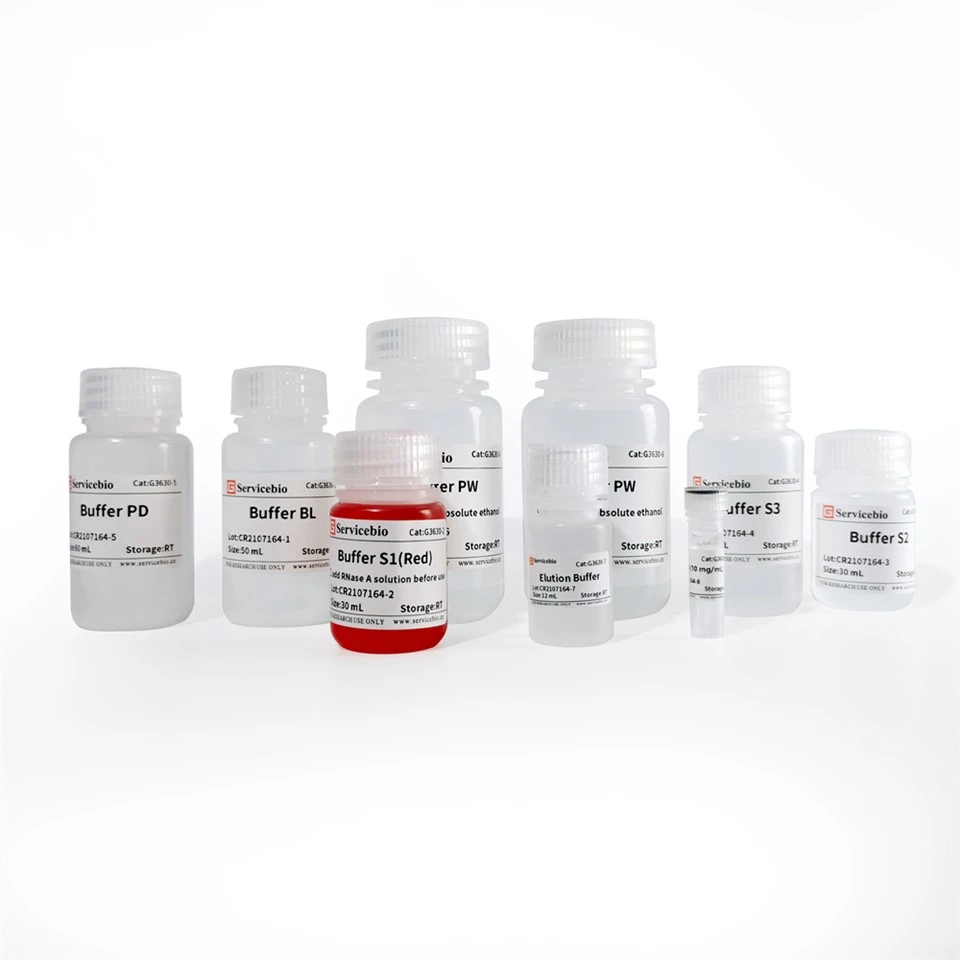
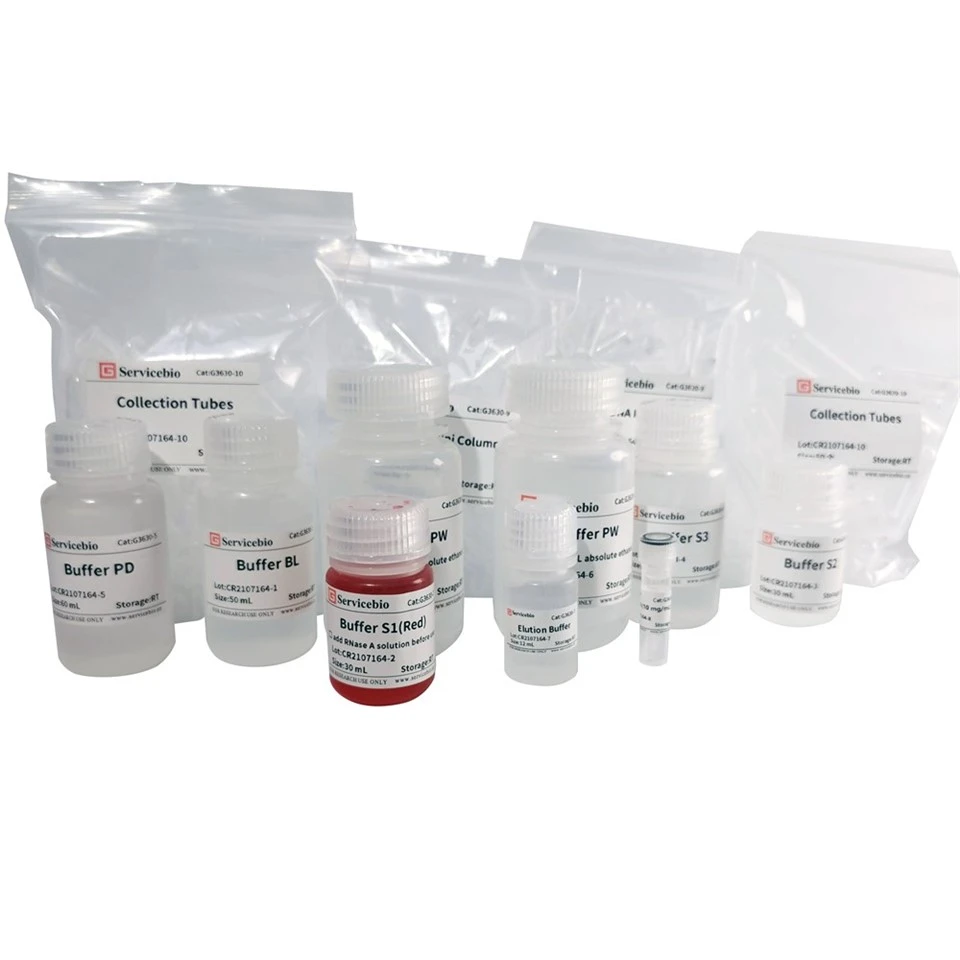
Product Contents
|
Component Number |
Component |
G3630-100T |
|
G3630-1 |
Buffer BL |
50 mL |
|
G3630-2 |
Buffer S1 (Red) |
30 mL |
|
G3630-3 |
Buffer S2 |
30 mL |
|
G3630-4 |
Buffer S3 |
40 mL |
|
G3630-5 |
Buffer PD |
60 mL |
|
G3630-6 |
Buffer PW |
2×15 mL |
|
G3630-7 |
Elution Buffer |
12 mL |
|
G3630-8 |
RNase A |
300 μL |
|
G3630-9 |
Bind DNA Mini Columns |
100 pcs |
|
G3630-10 |
Collection Tubes |
100 pcs |
|
Manual |
One copy |
|
Before starting (please read carefully)
1. Check the Buffer BL, Buffer S2, Buffer S3 and Buffer PD for a white precipitate. If present, place the buffer in a 37°C water bath for few minutes until the solution clears.
2. Add all RNase A solution to Buffer S1 (Red) and mix. The resuspension solution should be stored at 4℃.
3. Check that the specified amount of anhydrous ethanol is added before using Buffer PW.
4. For Columns balancing step, Buffer BL can improve the binding capacity, homogeneity and stability of the Bind DNA Mini Columnss, and eliminate the influence of high temperature, humidity or other adverse environmental factors on the Bind DNA Mini Columnss.
5. Assay Protocol / Procedures
6. Columns balance:
a. Put the Bind DNA Mini Columns into the collection tubess,;
b. add 500 μL of Buffer BL to the Bind DNA Mini Columnss, centrifuge at 10,000 x g for 1 min, discard the Columns flow through;
c. Put the Bind DNA Mini Columns back into the collection tubes (please use the fresh treated Columns on the day).
1. Bacteria collection: Centrifuge 1-5 mL of overnight fresh bacterial culture at 10,000 rpm for 1 minute and aspirate the supernatant as much as possible (when there is a large amount of bacteria, you can collect the bacterial precipitate into a single centrifuge tube by centrifuging several times).
2. Resuspension: Resuspend the cell pellet completely in 250 µL of Buffer S1 (please ensure RNase A has been added before using) by vortexing or gently pipetting up and down. After mixing, the solution is turbid red in color and is allowed to stand for 5 min at room temperature.
Note: Please ensure there is no bacterial clumps after lysis. Otherwise, it will affect the lysis procedure, resulting in low extraction amount and purity.
3. Lysis: Add 250 µL of Buffer S2 and mix gently by inverting the tube 6-8 times to to fully lyse the bacteria.
Note: mix well gently, do not shake violently; The mixture appears clear and viscous. If not, it may be due to too many bacteria and incomplete lysis, please reduce the volume of bacterial culture. After adding Buffer S2 and mixing thoroughly, the color of the solution is clear purple; if there is a cloudy red color mixed in with the purple color, the cleavage is insufficient, continue mixing until the color of the solution completely changes to clear purple; cleavage is recommended to be at room temperature for no more than 5 min.
1. Neutralization: Add 350 µL of the Buffer S3 to the centrifuge tube, and mix immediately and thoroughly by inverting the tube 6-8 times. A flocculent precipitate will appear, and centrifuge at 13,000 g for 10-15 min.
2. Note: Buffer S3 should be mixed immediately after adding, and a small amount of tiny white precipitate in the supernatant has no effect on subsequent experiments; There was a large amount of tiny white precipitate in the supernatant, and the supernatant could be taken after centrifugation again. After adding Buffer S3 and thoroughly mixing, the solution is clear yellow. If there is purple mixed in the yellow, it indicates that the renaturation is not sufficient. Continue to mix until the solution is completely clear yellow.), the collected supernatant was transferred to the Bind DNA Mini Columnss, taking care not to pipette precipitation as much as possible. After centrifugation again at 10,000 g for 1 min, the waste liquid was discarded and the Bind DNA Mini Columnss was put into the collection tubess.
3. Add 500 µL of the Buffer PD to the Bind DNA Mini Columns. Centrifuge at 10,000 g for 1 minute and discard the flow-through. Place the Columns back into the same collection tubes.
4. Add 700 µL of the Buffer PW (Please check whether 100% ethanol has been added before using) to the Bind DNA Mini Columns, centrifuge at 10,000 g for 1 min, discard the flow-through, place the Bind DNA Mini Columns back into the same collection tubes.
5. Note: If the recovered DNA is used for salt-sensitive experiments, such as flat end joining experiment or direct sequencing, it is recommended that Buffer PW be added and let stand for 2-5 min before centrifugation.
6. Repeat step 7.
4. Put the Bind DNA Mini Columns back into the same collection tubes, centrifuged at 10,000 x g for 2 minutes to remove residue. Place the Bind DNA Mini Columns at room temperature for 5 min and dried thoroughly.
7. Note: residual ethanol in rinse solution will affect subsequent enzyme digestion and PCR experiments).
8. To elute the plasmid DNA, transfer the the Bind DNA Mini Columns to a sterile microcentrifuge tube and add 50~100 μL of Elution Buffer or sterile water (preheat Elution Buffer or ddH2O at 60-65°C for better results) directly to the resin. Incubate for 2 minutes at room temperature. Centrifuge the the Bind DNA Mini Column/Collection Tubes at room temperature at 10,000 g for 2 minutes. The plasmid DNA is now eluted from the column.
9. Note: The volume of elution solution should not be less than 50 μL, and too small a volume will affect the efficiency of recovery. In order to increase the amount of DNA recovered, the solution obtained by centrifugation can be refilled back into the Bind DNA Mini Columns, left at room temperature for 2 min, centrifuged at 10,000 g for 2 min, and the DNA solution collected into the centrifuge tube. The pH of the eluent has a large impact on the elution efficiency. If sequencing is to be done subsequently, it is recommended to use ddH2O as the eluent and ensure that its pH is in the range of 7.0-8.5; a pH lower than 7.0 will reduce the elution efficiency; the DNA product should be stored at -20°C to prevent DNA degradation.
Note
1. The amount of plasmid extracted was related to the bacterial culture concentration and plasmid copy number. If the plasmid is low copy plasmid or large plasmid larger than 10 KB, the number of bacteria should be increased (5-10 mL for overnight bacterial culture) and the amount of Buffer S1, S2 and S3 should be increased in proportion. Elution Buffer should be preheated at 60-65°C in a water bath, which can be appropriately prolonged during adsorption and elution for extraction efficiency. Other steps are the same.
1. Please tighten the cap promptly after each solution is used to prevent the solvent from evaporating.
2. For your safe and health, please wear safety glasses, gloves, or protective clothing.
For Research Use Only!


