


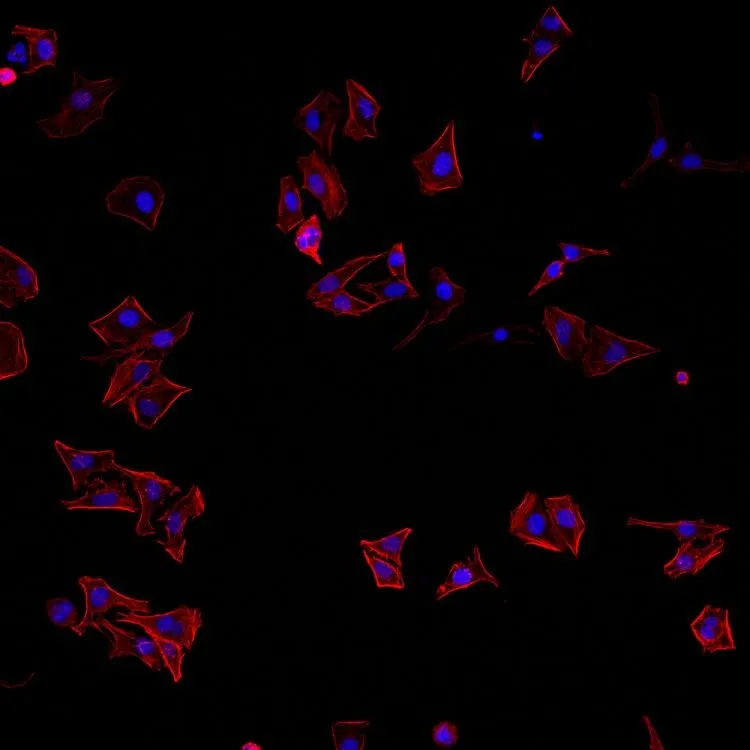
Product Information
|
Product Name |
Cat. No |
Spec. |
|
IF555-Phalloidin Stain |
G1249-100T |
100 T |
Introduction
Phalloidin, originally isolated as a bicyclic peptide from the poisonous mushroom Amanita phalloides, binds to actin filament F-actin with very high affinity and specificity, and does not bind monomeric actin (G-actin). Phalloidin have a similar affinity for small and large fibers, and essentially bind according to the stoichiometric ratio of one actin subunit to one phalloidin molecule in muscle and non-muscle cells of many different plant and animal species. Unlike actin antibodies, the affinity for motorized proteins changes markedly from one species or source to another. Nonspecific binding of phalloidin is almost negligible, and differences between stained and unstained regions are very pronounced. Phalloidin and their derivatives can stain F-actin at nanomolar concentrations, allowing very easy labeling, identification and quantitative study of F-actin distribution.
This product is a fluorescent dye IF555-labeled phalloidin,according to the use of 100 μL of working solution per well cell staining, this product can be used for 100 cell staining.
Storage and Handling Conditions
Transport with wet ice. Store at -20℃ away from light, valid for 12 months.
Components
|
Component |
G1249-100T |
|
IF555-Phalloidin Stain |
100 T |
|
Instruction Manual |
1 pc |
Pre-experiment preparation
1. Prepare your own 1×PBS buffer (pH 7.2-7.4, recommended G4202), BSA (recommended GC305010), fixative (containing 4% paraformaldehyde, recommended G1101), film-breaking solution (0.1%-0.5% Triton X-100 dissolved in PBS, recommended G1204), anti-fluorescence quenching sealer (recommended G1401), ready-to-use DAPI staining solution (recommended G1012), etc.
2. When using this product for the first time, fully melt and centrifuge at low speed for 1 min to prevent loss of liquid tube wall. It is recommended to dispense the product according to the amount used in a single experiment to prevent loss of solvent by volatilization. Store at -20℃ away from light.
3. Before formal experiments, PBS containing 1% BSA was prepared, i.e., 1.0 g BSA was dissolved per 100 mL of PBS. 1 μL of IF555-Phalloidin Stain was then aspirated and mixed with 200 μL-500 uL of PBS containing 1% BSA to obtain 1× of the Phalloidin Staining Working Solution. The staining effect may be different for different types of cells, please refer to the literature for the optimal staining working concentration or perform the pre-test to find out. Use the Phalloidin Staining Solution on the same day as it is prepared and stored at room temperature and protected from light.
Usage
1. Cultured cells were crawled (at a density of at least half confluence), the culture medium was removed, and the cells were washed with 1× PBS buffer pre-warmed at 37°C to wash the cells 2 times;
2. Fixative containing 3.0-4.0% formaldehyde was added to cover the cells and fixed for 15-30 min at room temperature;
Note: Methanol destroys actin, so the fixative must not contain methanol and avoid using formaldehyde solutions containing methanol;
3. Cells were washed with 1× PBS buffer 2-3 times for 10 min each at room temperature;
4. The cells were covered with PBS containing 0.1% Triton X-100 at room temperature and permeabilized for 5 min at room temperature;
5. Cells were washed with 1× PBS buffer 2-3 times for 10 min each at room temperature;
6. After the cell crawls were shaken dry slightly, draw a circle with a pap pen so that the cells were located in the center of the circle. Take 100 μL of the ready-made IF555-Phalloidin Staining Solution to cover the cells completely, and incubate at room temperature and away from light for 30-120 min. Note that normally, 4-37°C is suitable for staining. To avoid evaporation of the staining working solution leading to dry slices, the incubation process requires placing the cell crawls in a sealed container, such as a light-proof wet box. In addition, the addition of 1% BSA to the Phalloidin Staining Solution can effectively reduce the background;
7. Cells were washed with 1× PBS buffer 2-3 times for 5 min each time;
8. (Optional) Add drops of ready-to-use DAPI staining solution to the crawler slides to cover the cells, and perform nuclear staining for 3-5 min. wash the cells with 1× PBS buffer 2-3 times for 30-60 s each;
9. Cell crawls were slightly shaken dry and inverted on a slide with a drop of anti-fluorescence quenching sealer, and the for sealer was blotted off with a paper towel;
[Optional step]: After completing step 7, the coverslip can also be inverted directly onto a slide titrated with an anti-fluorescence quenching sealer containing DAPI (G1407 recommended), and the excess sealer can then be aspirated off. Observe the results by fluorescence microscopy or laser confocal microscopy.
10. The results were observed by fluorescence microscopy or laser confocal microscopy with the IF555(Ex/Em=556/574 nm)and DAPI (Ex/Em=364/454 nm) channels selected.
Note
1. One unit (T) of fluorescently labeled Phalloidin is defined as the amount of dye used to stain a slide of loaded cells.
2. Methanol can destroy actin protein, so fixation solution containing methanol should not be used in the early fixation of samples. The fixation time is recommended to be controlled between 15-30 min optimally.
3. Phalloidin is usually not permeable and is rarely used for live cell staining.
4. All fluorescent dyes are quenched, so it is recommended to complete the detection on the same day as possible after dyeing.
5. Phalloidin are toxic and should be handled with care. Wear a lab coat and disposable gloves during operation.
For Research Use Only!



