
Product Information
|
Product Name |
Cat. No. |
Spec. |
|
iF488-Wheat Germ Agglutinin(WGA,Green Light) |
G1730 |
100UL |
Product Description/Introduction
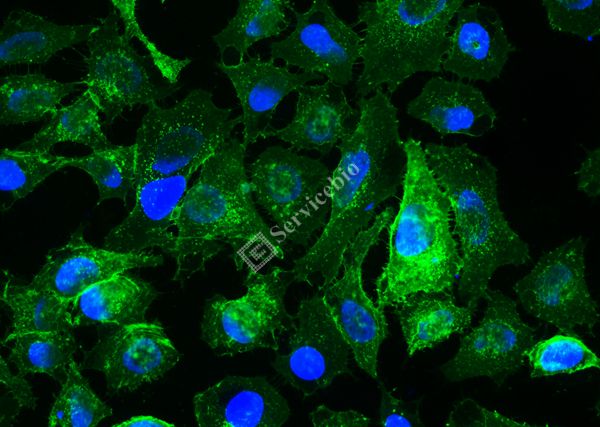
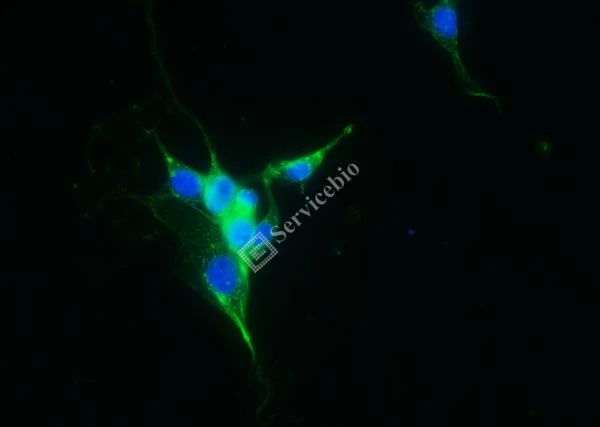
Wheat germ agglutinin (WGA) is a lectin that binds to N-acetyl-D-glucosamine and sialic acid, and is one of the most studied and widely used classes of lectins. It is currently the most studied and widely used class of lectins.WGA binds to glycoconjugates, and its derivatives and conjugates are widely used for labeling cell membranes and fibrotic scar tissues for fluorescence imaging and analysis. The carbohydrate-binding specificity of WGA is directed towards a sequence of β-1,4-GlcNAc-linked residues, known as chitin dextrins. Each monosaccharide contains two identical, noninteracting binding sites that are complementary to three or four β-1,4-GlcNAc units. Of the monosaccharides tested, only GlcNAc binds to WGA, ManNAc does not, and GalNAc binds only weakly.WGA binds with high affinity to internal GlcNAc residues in large oligosaccharides containing Gal β(1-4)GlcNAc β(1-3) (i.e., poly(aminolactose)-type glycans) repeats.N-acetylneuraminic acid participates in the low-affinity interaction of WGA only. WGA shows a complex pattern of glycan specificity that can be used for structural analysis of complex carbohydrates. The iFluor®488 affix of WGA is probably the brightest WGA affix. It exhibits the bright and green fluorescence of the iFluor®488 dye. iFluor®488 WGA affix binds to sialic acid and N-acetylglucosaminyl residues as does the AF488 WGA coupler.
Wheat Germ Agglutinin (WGA) is a 36 kDa lectin commonly used to label mammalian cells, cell membranes of Gram-positive bacteria and yeast, as well as skeletal and cardiac sacral membranes, among others, due to its property of coupling to N-acetyl-β-D-glucosaminyl residues and N-acetyl-β-D-glucosaminyl oligomers in cell membranes. When WGA is used for cardiomyocyte staining, the cell membranes of cardiomyocytes can be stained out so that whether they are hypertrophic or not can be seen from the comparison of the image with the normal group, and the diameter and area of the stained cells can also be measured with specialized software, enabling analysis of whether the cardiomyocytes are hypertrophic or not.
Storage and Shipping Conditions
Ship with wet ice; Store at -20℃ for 12 months.
Product Content
|
Component |
G1722-50UL |
|
iF488-Wheat Germ Agglutinin(WGA,Green Light) |
100 μL |
|
Manual |
1 pc |
Pre-experiment Preparation
1. Prepare your own1×PBS buffer (pH 7.2-7.4, recommendedG4202), fixative containing 3.0-4.0% formaldehyde (recommendedG1101, containing 4% PFA),anti-fluorescence quenching sealer(recommended G1401), and ready-to-use DAPI staining solution (recommendedG1012).
2. When using the product for the first time, centrifuge the fully melted product at low speed for 1 min to prevent loss of liquid tube wall. It is recommended to dispense the product according to the amount used in a single experiment to prevent the loss of solvent by volatilization. Store at -20℃ away from light.
3. Before formal experiments, aspirate 5 μL iF488-Wheat Germ Agglutinin (WGA,GreenLight) and mix with 1 mL PBS to getiF488-WGA working solution. The staining effect may be different for different types of cells, please refer to the literature for the optimal staining working concentration or conduct pre-test to find out. iF488-WGA working solution is ready to use, stored at room temperature and protected from light, and used on the same day.
Assay Protocol / Procedures
Live cell staining (12-well plate as an example)
1. Wash the cells with 1×PBS buffer for 2 times.
2. Add 100 μL of iF488-WGA working solution to each well of cells and incubate for 10-30 min at 37°C, protected from light.Take care of sealing to prevent liquid evaporation. Remove the incubation solution and wash with buffer solution 2-3 times for 3-5 min each time.
3. After the incubation was completed, the cells were washed three times with 1× PBS buffer buffer for 5 min each time.
4. Results were observed by fluorescence microscopy or laser confocal microscopy.
Fixed cell staining (6-well plate cell crawler as an example)
1. Cultured cells were crawled (at a density of at least 50% confluence), the culture medium was removed, and the cells were washed twice with 1× PBS buffer pre-warmed at 37°C.
2. Add appropriate amount of fixative to cover the cells and fix for 10-30 min at room temperature.
3. The fixative was aspirated and the cells were washed with 1× PBS buffer at room temperature 2-3 times for 10 min each.
4. After the cell crawler was slightly shaken dry, draw a circle with a histochemical pen so that the cells were located in the center of the circle. Take 100 μL of iF488-WGA working solution to cover the cells completely and incubate at 37°C for 30 min away from light.Be careful to seal and prevent the liquid from evaporating to dry the slides.
5. After the incubation was completed, the cells were washed three times with 1× PBS buffer for 5 min each time.
6. (Optional) Drops of ready-to-use DAPI staining solution were added to the crawler slides to cover the cells, and nuclear staining was performed for 8 min.The cells were washed with 1× PBS buffer 2-3times for 30 s-1 min each time.
7. Cell crawls were slightly shaken dry and inverted onto a slide with a drop of anti-fluorescence quenching sealer, and excess sealer was blotted off with a paper towel.
[Note] Steps 6 and 7, can be replaced with DAPI-containing anti-fluorescence quenching sealer (Recommendation G1407), which accomplishes staining of the nuclei and sealing of the film at the same time.
8. The results were observed by fluorescence microscopy or laser confocal microscopy with 488 (Ex/Em=493/517 nm) and DAPI (Ex/Em=364/454 nm) channels selected.
Staining of tissue sections
1. Tissue sectioning pre-treatment:
Frozen sections (fresh tissue frozen sections or fixed tissue frozen sections) were left to stand at room temperature for several minutes and returned to room temperature; sections were submerged in fixative for 10-15 min at room temperature, removed and dried naturally, and then moistened and washed in purified water or 1×PBS buffer to remove the residual fixative on the tissue.
Paraffin sections were dewaxed and rehydrated;
Tissue sections (paraffin sections or frozen sections of fixed tissues) were placed in a repair cassette filled with EDTA antigen repair buffer (pH 8.0) in a microwave oven for antigen repair. Medium heat for 8 min cease fire for 8 min to medium-low heat for 7 min, this process should prevent excessive evaporation of buffer, do not dry the slides. After natural cooling, the slides were placed in 1×PBS buffer and washed by shaking on a decolorizing shaker for 3 times, each time for 5 min.
2. Staining: Draw a circle around the tissue with a histochemical pen after the tissue section is slightly dried. Add 50-100 μL of iF488-WGA working solution to the circle to cover the tissue, and incubate at 37℃ away fromlight for 30 min. Take care of sealing to prevent the liquid from evaporating and drying the slides.
3. Wash: After the incubation was completed, the samples were washed three times with 1× PBS buffer for 5 min each time.
4. Nucleus staining (optional): dropwise add ready-to-use DAPI staining solution to the sample to cover the cells, and perform nucleus staining for 8 min.Wash the sample with 1×PBS buffer 2-3 times for 30 s-1 min each time.
5. Sealing: After the sections are slightly shaken dry, add a drop of Anti-fluorescence quenching sealer to the sample and seal it with a suitable coverslip.
[Note] Steps 4 and 5, can be replaced with DAPI-containing anti-fluorescence quenching sealer (Recommendation G1407), which accomplishes staining of the nucleus and sealing of the film at the same time.
6. Microscopy: Fluorescence microscopy or laser confocal microscopy to observe the results, selecting the 488 (Ex/Em=493/517 nm) and DAPI (Ex/Em=364/454 nm) channels.
Note
1. Samples that have been fixed for a long period of time (e.g., paraffin sections) must be subjected to a pyrolysis repair process or else the positive results will be weak or close to none.
2. WGA staining for myocardial analysis requires a high level of myocardial tissue, which must be complete and homogeneous, and it is best to provide specimens of paraffin sections.
3. For cellular samples, avoid the use of permeabilizing solutions prior to staining, as this may cause staining of cytoplasmic structural components.
4. Fluorescent dyes are subject to quenching, and it is recommended that testing and observation photos be completed as soon as possible after staining.
5. Please wear lab coat and gloves during operation.
For Research Use Only!
Ver. No.:V1.0-202403


