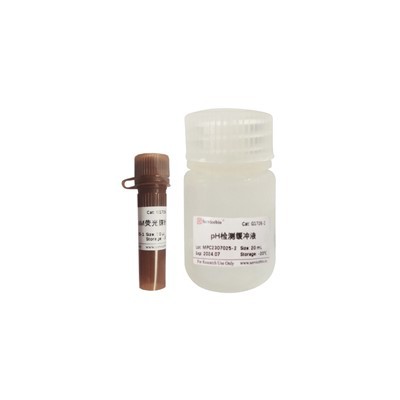
Product Information
|
Product Name |
Cat. No. |
Spec. |
|
Dihydroethidium |
G1904-100T |
100 T |
Product Description/Introduction
Dihydroethidium (DHE), is a commonly used fluorescent detection probe for superoxide anions. DHE freely enters the cell and dehydrogenates in the presence of intracellular superoxide anions to produce ethidium bromide. Ethidium bromide binds to intracellular nucleic acids and produces red fluorescence. When the intracellular superoxide anion level is high, the more ethidium bromide is produced, the higher the fluorescence intensity, and vice versa the weaker the fluorescence intensity. Therefore, it can be used to detect the level of intracellular superoxide anion.
Storage and Shipping Conditions
Ship with dry ice; Store at -20℃ away from light for 6 months.
Product Content
|
Component |
G1904-100T |
|
Dihydroethidium |
100 μL |
|
Manual |
1 pc |
Note: The above reaction counts were assayed for a 6-well plate system.
Assay Protocol / Procedures
1. This product is a 5 mM Dihydroethidium (superoxide anion fluorescent probe) masterbatch, which is diluted into a DHE working solution (usually 1-10 μM is sufficient for the experiment) using appropriate medium or buffer;
2. Wash normal or treated cells 1-2 times with PBS or other buffers;
3. After removing the washing buffer, add 1 mL of DHE working solution and incubate for 30 min in a cell culture incubator protected from light;
4. Remove the DHE working solution and wash 1-2 times with PBS or other buffers;
5. Test under the corresponding instrument; DHE itself is blue fluorescence, Ex is 355 nm, Em is 420 nm; When DHE dehydrogenates and binds to nucleic acid, it shows red fluorescence, Ex is 520 nm, Em is 605 nm.
Note
1. Due to the different types and properties of the cells, the working concentration of the probe and the incubation time can be adjusted appropriately according to the needs of the experiment.
2. Probe working solution, washing buffer, etc. need to be pre-warmed and processed in advance to avoid temperature difference stimulation affecting the cells.
3. The fluorescent dyes are subject to quenching, and the process should be protected from light.
4. Dihydroethidium is easily oxidized in air, avoid exposure to air as much as possible, it is recommended to store in small portions and avoid repeated freezing and thawing.
5. For your health and safety, please wear lab coat and gloves during operation.
For Research Use Only!