

Product Introduction
|
Product Name |
Cat.No. |
Spec. |
|
Magnetic Plant RNA extraction kit |
G3619-50T |
50T |
Description/Introduction
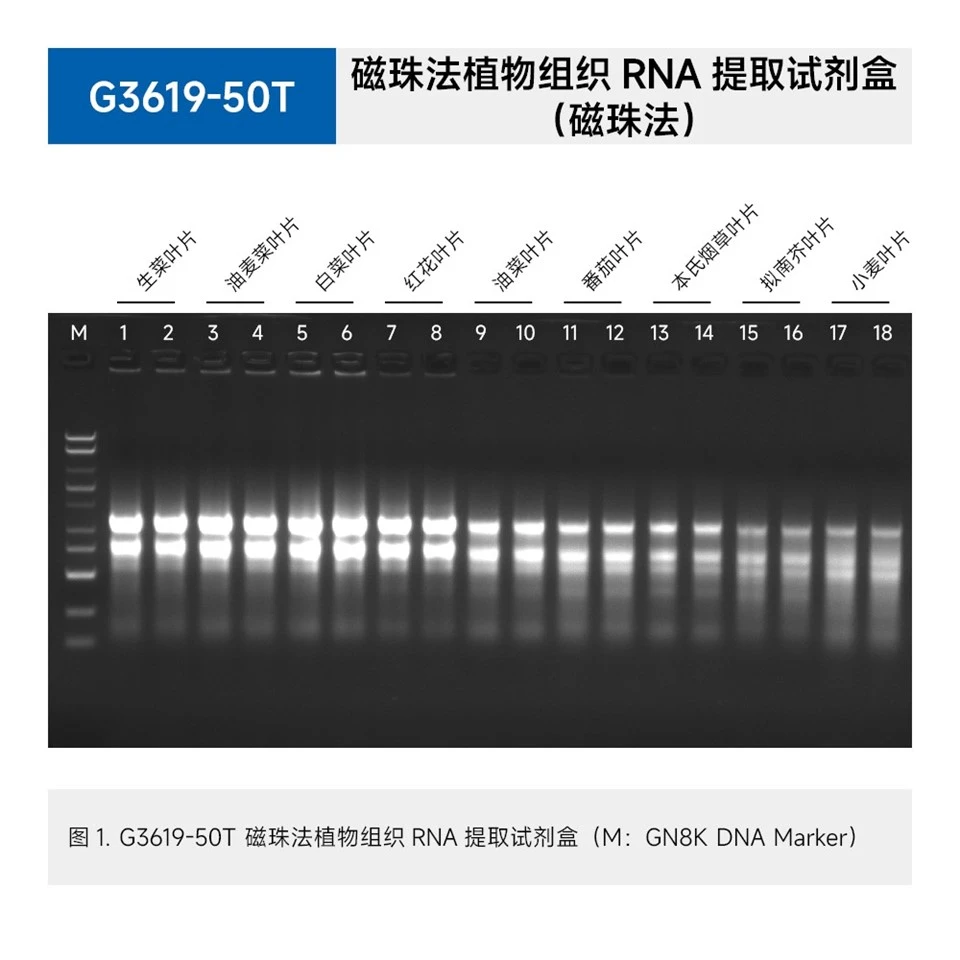
Using superparamagnetic magnetic beads specially developed for nucleic acid extraction and purification and specially optimized lysis buffer system, this kit can specifically bind RNA of plant tissue samples and remove other impurities except nucleic acids in the samples. The kit does not need phenol, chloroform and other reagents. The operation is simple and fast, no need for multi-step centrifugation. This kit can quickly extract high purity and high integrity RNA from 50-100 mg simple plant tissue samples (such as wheat, corn leaves, etc.).
Storage and Handling Conditions
DNase, DTT Solution is transported in wet ice and stored at -20°C; The remaining reagents are transported and stored at room temperature; The expiration date is 12 months.
Product Contents
|
Component Number |
Component |
G3619-50T |
|
G3619-1 |
Buffer PRL1 |
30 mL |
|
G3619-2 |
Buffer PRL2 |
8 mL |
|
G3619-3 |
Buffer PRL3 |
30 mL |
|
G3619-4 |
Buffer RWA |
16 mL |
|
G3619-5 |
Buffer RWB |
24 mL |
|
G3619-6 |
SweMag Beads |
1.5 mL |
|
G3619-7 |
DTT Solution |
1.2 mL |
|
G3619-8 |
DNase |
500 μL |
|
G3619-9 |
10×DNase Buffer |
1 mL |
|
G3619-10 |
Nuclease-free Water |
10 mL |
|
Manual |
One copy |
|
Before starting (please read carefully)
1. If Buffer PRL1 precipitates, please heat it at 37°C and use it when it is restored to room temperature.
2. Before use, please add DTT Solution to Buffer PRL3 until the final concentration is 4%, that is, add 40 µL DTT Solution to 1 mL Buffer PRL3. This lysate is best prepared fresh, Buffer PRL3 added to DTT Solution can be stored at 4℃ for one month.
3. Before use, please add 24 mL absolute ethanol to Buffer RWA and 96 mL absolute ethanol to Buffer RWB.
4. When grinding with the grinder, precool the grinder in advance.
5. Self-provided magnetic frame.
Assay Protocol / Procedures
1. Lysis of plant tissues:
Transfer 50-100 mg fresh or cryopreserved plant tissue to a 2.0 mL Nuclease-free grinding tube (recommended HT-200-M) containing 3-4 3 mm zirconia beads (recommended G0203-150G) and pre-cooled with liquid nitrogen. Place the grinding tube on the grinder (recommended KZ-5F-3D) (quickly precool the adapter in liquid nitrogen before placing the grinding tube. Recommended grinding procedure: set the frequency to 60 HZ, temperature to 4℃,grind for 30 seconds each time, repeating the process 4 times, with a 5 second interval between each grind) and grind until it is completely powdered (If the tissue is not completely ground to powder, it will affect the yield and quality of RNA. The grinding times can be extended until the tissue is fully ground). Once the grinding is completed, add 500 μL Buffer PRL1 to the grinding tube, mix the contents upside down and incubate at 56°C for 15 min, mixing upside down every 5 min.
2. Centrifuge at 12,000 rpm for 5 min at room temperature, transfer the supernatant to a new 1.5 mL centrifuge tube. Add 1/5 supernatant volume of Buffer PRL2, fully upside down and mix well.
3. Centrifuge at 12,000 rpm for 5 min at 4℃, transfer the supernatant to a new 2.0 mL centrifuge tube. Add 500 μL Buffer PRL3 to the supernatant (make sure you have added DTT Solution before use), fully upside down and mix well.
4. Add 2/3 volume of ethanol to the mixture from the previous step, fully upside down and mix well. Then add 30 μL SweMag Beads (SweMag Beads should be evenly dispersed before use) and mix well with pipette or vortex oscillation.
5. Stand at room temperature for 10 min, and during the placement process, the SweMag beads were mixed multiple times using pipette blowing or vortex oscillation in order to maintain the suspension of the SweMag Beads.
6. Transfer the centrifuge tube to the magnetic frame and let it stand for 30 s. When the supernatant is clear, aspirate and discard the supernatant.
7. Add 600 μL Buffer RWA, remove the magnetic frame, use a pipette to blow or vortex shake until the magnetic beads are well dispersed. Transfer the centrifuge tube to a magnetic frame and let it stand for 30 s. When the supernatant is clear, aspirate and discard the supernatant.
8. Add 700 μL Buffer RWB, remove the magnetic frame, use a pipette to blow or vortex shake until the magnetic beads are well dispersed. Transfer the centrifuge tube to a magnetic frame and let it stand for 30 s. When the supernatant is clear, aspirate and discard the supernatant.
9. remove the magnetic frame, and perform DNase digestion:
a) preparation of DNase reaction solution: Mix 10 μL 10 × DNase Buffer, 10 μL DNase, 80 μL Nuclease-free Water in a new 1.5 mL Nuclease-free centrifuge tube;
b) add 100 μL DNase reaction solution to the centrifuge tube containing the magnetic beads. Use a pipette to blow or vortex shake until the magnetic beads are well dispersed. Stand at room temperature at 15 min, during which time the magnetic beads are mixed with a pipette every 5 min;
c) add 600 μL Buffer RWB, use a pipette to blow or vortex shake until the magnetic beads are well dispersed. Transfer the centrifuge tube to a magnetic frame and let it stand for 30 s. When the supernatant is clear, aspirate and discard the supernatant.
10. Repeat step 8.
11. Open the cap of the centrifuge tube and stand at room temperature for 5-10 min, so that the residual ethanol can be evaporate completely (avoid over-drying of the magnetic beads, which may affect the nucleic acid yield).
12. Remove the magnetic frame, Add 100-150 μL Nuclease-free Water to the centrifuge tube, use a pipette to blow or vortex shake until the magnetic beads are well dispersed. Stand at room temperature for 5 min.
13. Transfer the centrifuge tube to the magnetic frame until the magnetic beads were fully adsorbed and absorb the supernatant into a new 1.5mL Nuclease-free centrifuge tube to obtain high purity RNA.
Note
1. Please read this product manual carefully before operation.
2. The magnetic bead should avoid freezing during storage; the magnetic bead is easy to settle and should be fully shaken before use to keep it in a uniform suspension state.
3. Before adding magnetic beads to the sample, the reagents in the sample need to be mixed well.
4. The ethanol should be completely volatilized before eluting RNA to avoid residual ethanol affecting downstream experiments.
5. Do not dry the beads for a long time as this may affect the RNA elution efficiency.
6. Wear lab coats, disposable gloves and masks during the experiment, avoid talking, and use Nuclease-free tips and centrifuge tubes to avoid cross-contamination.
Schedule
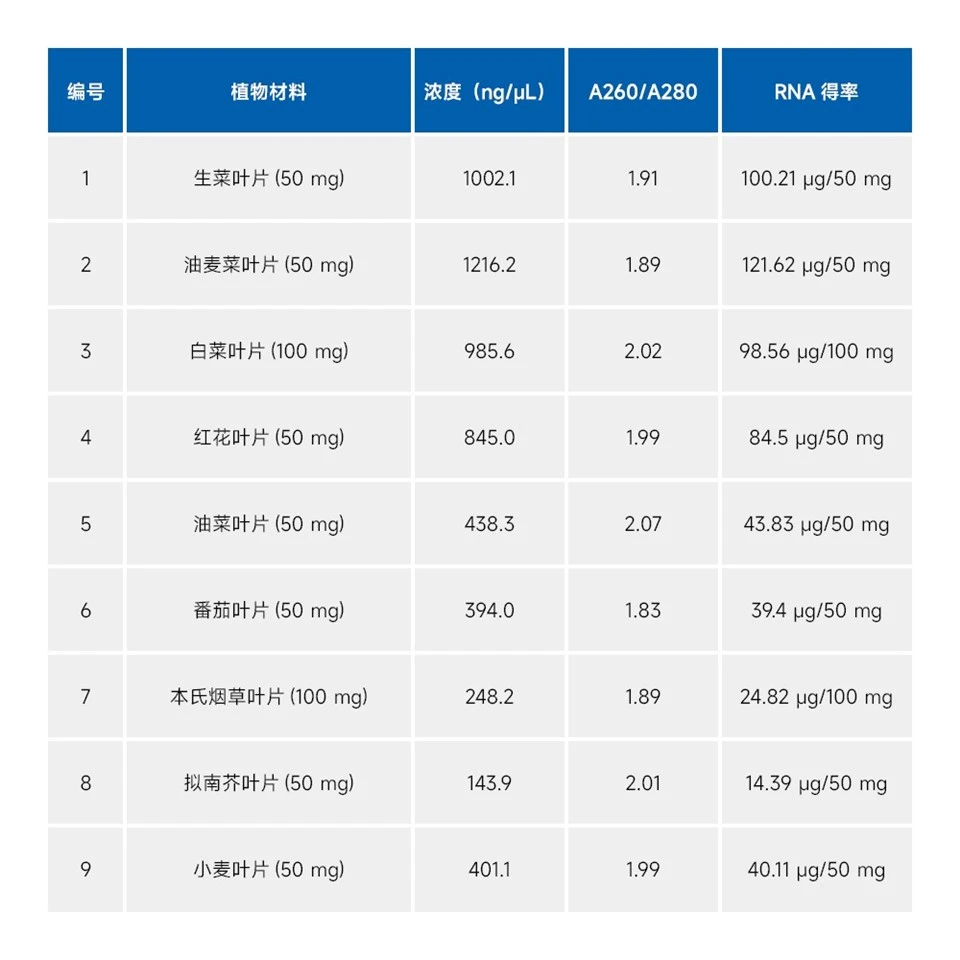
The RNA yield extracted from a variety of plant and fungus sample by this kit is shown in the table below. RNA yield is related to plant species, organs, freshness and growth status. The following table is for reference only.
|
Sample name |
RNA yield |
|
Lactuca sativa L. var. ramosaleaf |
90-100 μg/50 mg |
|
Lactuca sativaleaf |
100-110 μg/50 mg |
|
Brassica pekinensisleaf |
80-90 μg/50 mg |
|
Carthamus tinctoriusleaf |
70-80 μg/50 mg |
|
Brassica napusleaf |
35-45 μg/50 mg |
|
Lycopersicon esculentumleaf |
30-40 μg/50 mg |
|
Nicotiana benthamianaleaf |
20-25 μg/40 mg |
|
Arabidopsis thalianaleaf |
15-20 μg/50 mg |
|
Triticum aestivumleaf |
30-40 μg/50 mg |
For Research Use Only!


