
Product Introduction
|
Product Name |
Cat.No. |
Spec. |
|
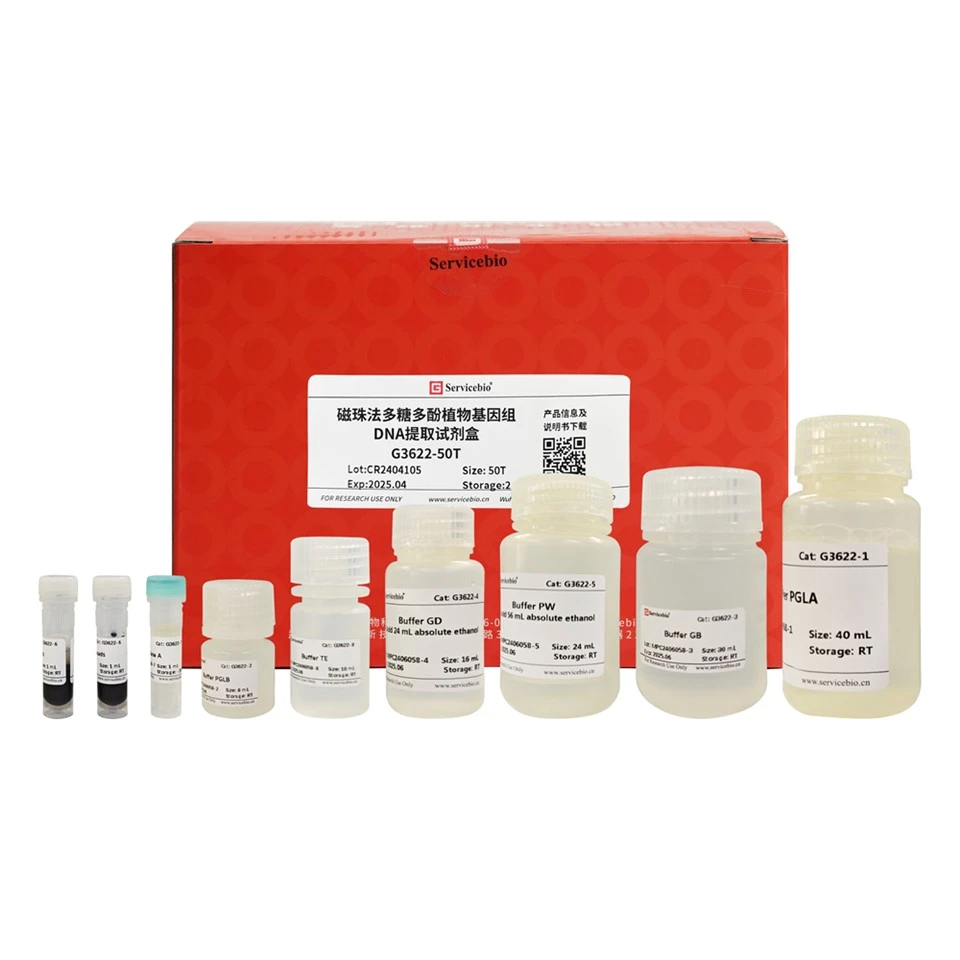
MagBind Plant Genomic DNA Extraction Kit For Polysaccharides & Polyphenolics |
G3622-50T |
50T |
Description/Introduction
Through the specially optimized lysis buffer system, combined with the characteristics of specific binding of superparamagnetic beads to DNA, this kit can extract genomic DNA safely, quickly and efficiently from 20-300 mg (the initial amount of plant tissue varies depending on the sample) plant tissue samples (leaves, seeds, fruits, etc) rich in polysaccharides and polyphenols. The specially optimized lysis buffer system can remove impurities such as polysaccharides, polyphenols, proteins and cell fragments from plant samples. This kit does not require phenol, chloroform and other organic reagents, and does not require multi-step centrifugation. The extracted genomic DNA can be used in subsequent PCR reaction, enzyme digestion reaction, Southern hybridization, RAPD, AFLP, RFLP and many conventional molecular biology experiments.
Storage and Handling Conditions
RNase A is shipped with wet ice and stored at -20°C; The remaining reagents are shipped and stored at room temperature; The expiration date is 12 months.
Product Contents
|
Component Number |
Component |
G3622-50T |
|
G3622-1 |
Buffer PGLA |
40 mL |
|
G3622-2 |
Buffer PGLB |
8 mL |
|
G3622-3 |
Buffer GB |
30 mL |
|
G3622-4 |
Buffer GD |
16 mL |
|
G3622-5 |
Buffer PW |
24 mL |
|
G3622-6 |
SweMag Beads |
2×1 mL |
|
G3622-7 |
RNase A |
1 mL |
|
G3622-8 |
Buffer TE |
10 mL |
|
Manual |
One copy |
|
Before starting (please read carefully)
1. If Buffer PGLA precipitates, please heat it at 65°C and use it when it is restored to room temperature.
2. Before use, please add 24 mL anhydrous ethanol to Buffer GD and 56 mL anhydrous ethanol to Buffer PW, mix well and use.
3. The initial amount of plant tissue samples has a great influence on the extraction effect of gDNA. If the initial amount is too much, the extraction quality and relative yield of gDNA will be reduced. Before starting the experiment, please refer to the following Table 1 for different initial amounts of plant tissue samples and the appropriate amount of Buffer PGLA.
Table 1 Usage of Buffer PGLA corresponding to different initial amounts of plant tissue samples
|
Plant tissue samples type |
Initial amount of plant tissue samples |
Buffer PGLA usage |
Buffer PGLB usage |
|
Plant leaves, seeds |
≤50 mg |
500 μL |
100 μL |
|
50-100 mg |
750 μL |
150 μL |
|
|
Plant fruit, tuber |
100-300 mg |
500 μL |
100 μL |
Note: The recommended initial amount of leaf samples is 50-100 mg; The recommended initial amount of plant seed samples is 20-100 mg; The recommended initial amount of fruit and tuber samples is 100-300 mg.
4. Self-provided magnetic stand.
Assay Protocol / Procedures
1. Lysis of plant tissue samples:
a. Lysate + Grinder Grinding cracking: (Recommended) Add appropriate amount of Buffer PGLA (recommended usage in Table 1) to a 2.0 mL Nuclease-free grinding tube (recommended HT-200-M) in advance, and then add 3-4 4 mm stainless steel beads (recommended G0104-200G). Next, quickly transfer 20-300 mg fresh or cryopreserved plant tissue to the grinding tube (leaf samples are cut to 0.5 cm2, seed samples are preferentially shelled and chopped, fruit and tuber samples are chopped to 0.5 cm2). Place the grinding tube on the grinder (recommended KZ-5F-3D) and grind (recommended grinding procedure: set the frequency to 70 HZ, grind for 30 seconds each time, repeating the process 15-20 times with a 5 second interval between each grind. If the sample is difficult to grind, such as seeds, you can increase the grinding times to 30 or more) until the grinding is homogenized (if the tissue is not thoroughly homogenized, it will affect the yield and quality of DNA). After full grinding, add 20 μL RNase A to the grinding tube, mix upside down and incubate at 65°C for 15 min, mixing upside down every 5 min.
b. Liquid nitrogen + Grinder Grinding cracking: Quickly transfer 20-300 mg fresh or cryopreserved plant tissue to a 2.0 mL Nuclease-free grinding tube (recommended HT-200-M, leaf samples are cut to 0.5 cm2, seed samples are preferentially shelled and chopped, fruit and tuber samples are chopped to 0.5 cm2) containing 3-4 3 mm zirconia beads (recommended G0203-150G) and pre-cooled with liquid nitrogen. Place the grinding tube on the grinder (recommended KZ-5F-3D) (quickly precool the adapter in liquid nitrogen before placing the grinding tube) and grind until it is completely powdered (if the tissue is not completely ground to powder, it will affect the yield and quality of DNA). Then add appropriate amount of Buffer PGLA (recommended usage in Table 1) and mix well, add 20 μL RNase A to the grinding tube, mix upside down and incubate at 65°C for 15 min, mixing upside down every 5 min.
c. Liquid nitrogen + Mortar Grinding cracking: Quickly transfer 20-300 mg fresh or cryopreserved plant tissue to a Mortar pre-cooled with liquid nitrogen (leaf samples are cut to 0.5 cm2, seed samples are preferentially shelled and chopped, fruit and tuber samples are chopped to 0.5 cm2). Add liquid nitrogen and grind the tissue with a pestle, adding liquid nitrogen continuously until it is completely powdered (if the tissue is not completely ground to powder, it will affect the yield and quality of DNA). Then transfer the powdered samples to a 1.5 mL Nuclease-free centrifuge tube containing appropriate amount of Buffer PGLA (recommended usage in Table 1) and mix well. And add 20 μL RNase A to the centrifuge tube, mix upside down and incubate at 65°C for 15 min, mixing upside down every 5 min.
d. Liquid nitrogen + Pestle stick Grinding cracking: Quickly transfer 20-300 mg fresh or cryopreserved plant tissue to a 1.5 mL Nuclease-free centrifuge tube pre-cooled with liquid nitrogen (leaf samples are cut to 0.5 cm2, seed samples are preferentially shelled and chopped, fruit and tuber samples are chopped to 0.5 cm2). Add liquid nitrogen and grind the tissue with a pestle stick, adding liquid nitrogen continuously until it is completely powdered (if the tissue is not completely ground to powder, it will affect the yield and quality of DNA). Then add appropriate amount of Buffer PGLA (recommended usage in Table 1) to the centrifuge tube and mix well. And add 20 μL RNase A to the centrifuge tube, mix upside down and incubate at 65°C for 15 min, mixing upside down every 5 min.
2. Add 100-150 μL Buffer PGLB (recommended usage in Table 1) to the centrifuge tube, mix well, and place on ice for 5 min.
3. Centrifuge at 12,000 rpm for 5 min at 4℃, transfer the supernatant to a new 2.0 mL Nuclease-free centrifuge tube (if there is still floating matter in the obtained supernatant, it is necessary to centrifuge at 12,000 rpm for 5 min at 4°C again and transfer the supernatant to another new 2.0 mL Nuclease-free centrifuge tube, note: the supernatant obtained should not exceed 500 μL).
4. Add Buffer GB of the same amount of supernatant liquid volume into the supernatant of the previous step, and fully upside down and mix well.
5. Add the same volume of isopropanol to the mixture from the previous step, fully upside down and mix well. Then add 40 μL SweMag Beads (SweMag Beads should be evenly dispersed before use) and mix well with pipette or vortex oscillation.
6. Stand at room temperature for 10 min, and during the placement process, use the pipette to blow or vortex to mix several times to keep the SweMag Beads in suspension.
7. Transfer the centrifuge tube to the magnetic stand and let it stand for 30 s. When the supernatant is clear, aspirate and discard the supernatant.
8. Add 600 μL Buffer GD, remove the magnetic stand, use a pipette to blow or vortex until the SweMag Beads are well dispersed. Transfer the centrifuge tube to the magnetic stand and let it stand for 30 s. When the supernatant is clear, aspirate and discard the supernatant.
9. Add 700 μL Buffer PW, remove the magnetic stand, use a pipette to blow or vortex until the SweMag Beads are well dispersed. Transfer the centrifuge tube to the magnetic stand and let it stand for 30 s. When the supernatant is clear, aspirate and discard the supernatant.
10. Repeat step 9.
11. Open the cap of the centrifuge tube and stand at room temperature for 5-10 min, so that the residual ethanol can be evaporated completely (avoid over-drying of the SweMag Beads, which may affect the nucleic acid yield).
12. Remove the magnetic stand, add 80-100 μL Buffer TE or Nuclease-free Water to the centrifuge tube, use a pipette to gently blow or vortex until the SweMag Beads are well dispersed. Stand at room temperature for 5 min.
13. Transfer the centrifuge tube to the magnetic stand until the SweMag Beads were fully adsorbed and absorb the supernatant into a new 1.5 mL Nuclease-free centrifuge tube to obtain high purity DNA.
Note
1. Please read the product manual carefully before use.
2. Try to use fresh plant tissue to ensure the yield and integrity of genomic DNA.
3. The cryopreserved plant samples should avoid repeated freezing and thawing, otherwise the quality and yield of extracted DNA will be reduced.
4. For plant tissues with high nucleic acid content, the initial amount of plant tissue samples can be appropriately reduced to make it fully lysed; for samples with low nucleic acid content, the initial amount of plant tissue samples can be appropriately increased to obtain a higher concentration of genomic DNA.
5. For the plant samples with high water content and low nucleic acid content (such as tomato fruits, potato tubers, succulent plant leaves, etc), we can appropriately increase the initial sample size and reduce the amount of Buffer PGLA in the lysate to ensure that the volume of the supernatant is not more than 500 μL, so that the concentration of genomic DNA is higher, but we should pay attention to reducing the amount of Buffer PGLB in the same proportion.
6. Avoid freezing magnetic beads suspensions during storage. Magnetic beads are easy to settle, and should be fully vortex before use to keep them in uniform suspension.
7. Before adding magnetic beads to the sample, the reagents in the sample need to be mixed well.
8. Ethanol should be completely evaporated before elution of DNA to avoid the influence of residual ethanol on downstream experiments.
9. Do not dry magnetic beads for a long time to avoid affecting DNA elution efficiency.
Schedule
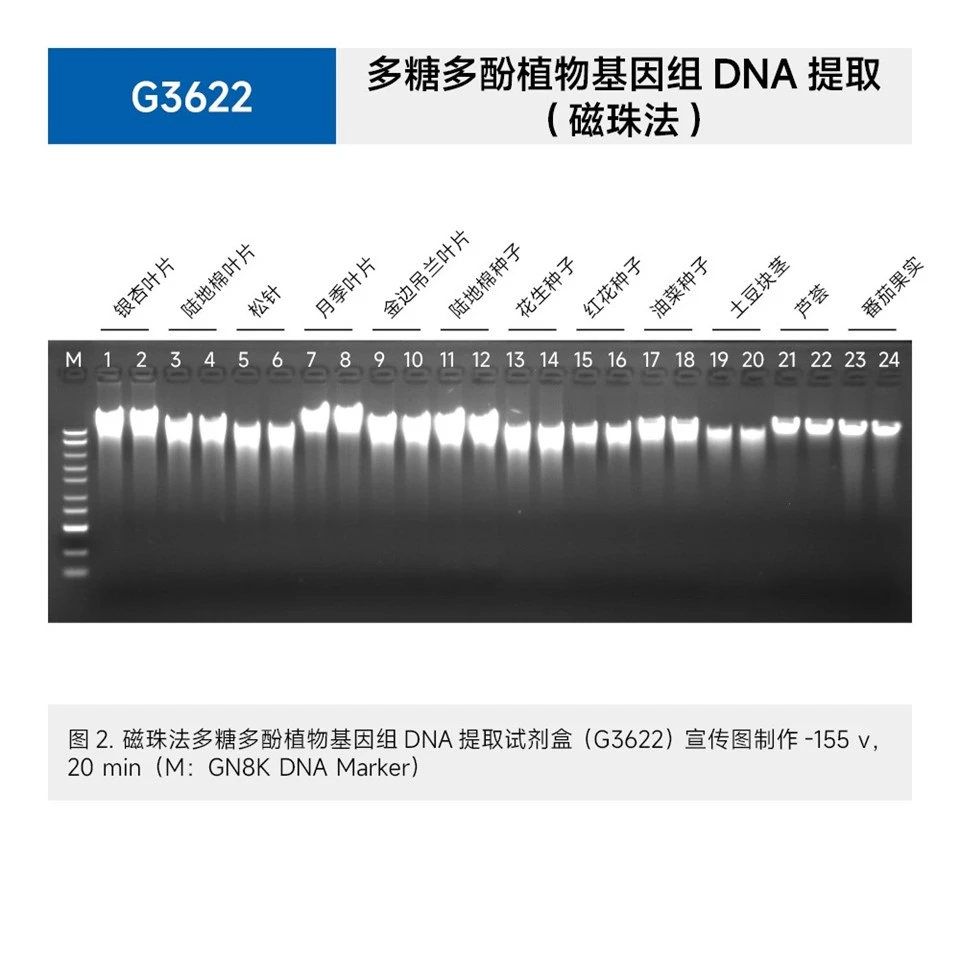
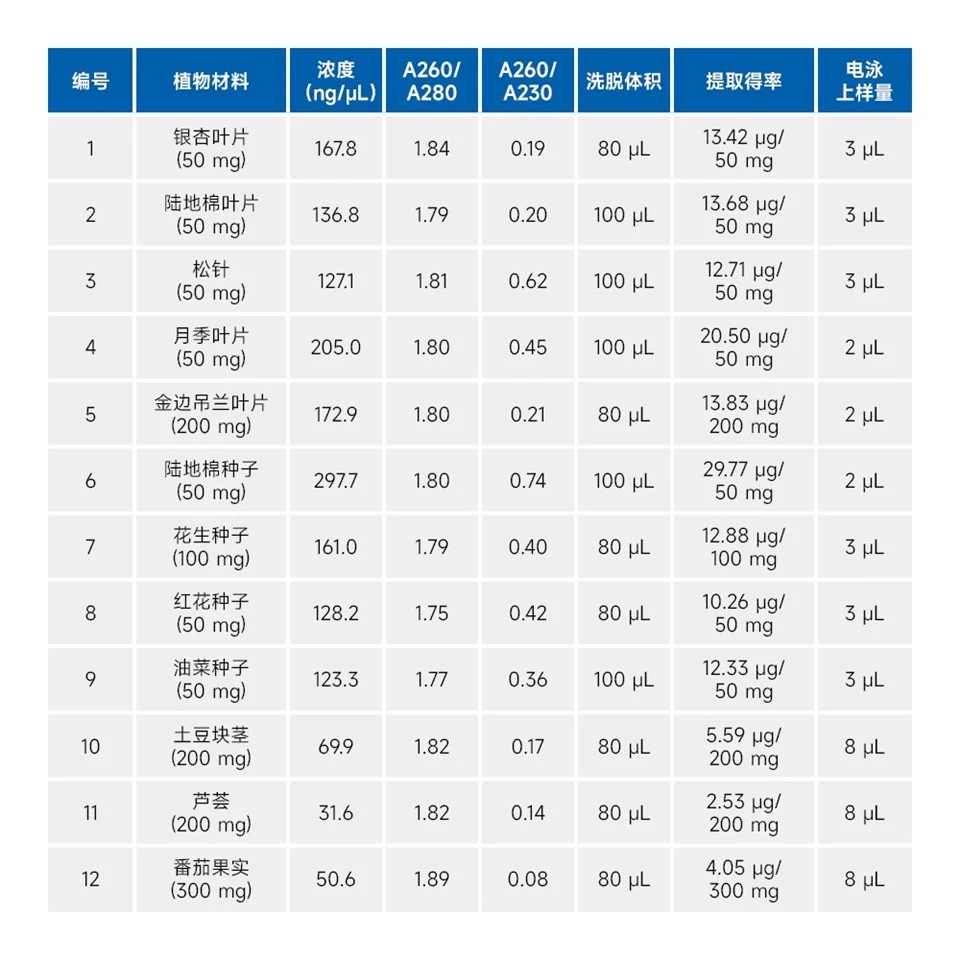
The genomic DNA yield extracted from many plant samples by this kit is shown in the table below. Genomic DNA yield is related to plant species, organs and growth status. The following table is for reference only.
|
Sample name |
Sample size |
DNA yield |
|
Ginkgo biloba leaf |
50 mg |
10-15 μg |
|
Gossypium hirsutum leaf |
50 mg |
7~10 μg |
|
Rosa chinensis leaf |
30 mg |
15-20 μg |
|
Arachis hypogaea seed |
100 mg |
10-15 μg |
|
Carthamus tinctorius seed |
50 mg |
8-12 μg |
|
Solanum tuberosum tuber |
200 mg |
4-7 μg |
|
Solanum lycopersicum Fruit |
300 mg |
2-5 μg |
For Research Use Only!
Hot Tags: magbind plant genomic dna extraction kit for polysaccharides & polyphenolics, China magbind plant genomic dna extraction kit for polysaccharides & polyphenolics manufacturers, suppliers, factory, glass plates set, High Purity Plasmid DNA Miniprep Kit, embed tissue, high current lab power supply, 10 Purple DNA Loading Buffer, EBSS Without Calcium Without Magnesium Without Phenol Red



