
Product Introduction
|
Product Name |
Cat.No. |
Spec. |
|
SDS-PAGE Gel Preparation Kit |
G2003-50T |
50 T |
Product Description/Introduction
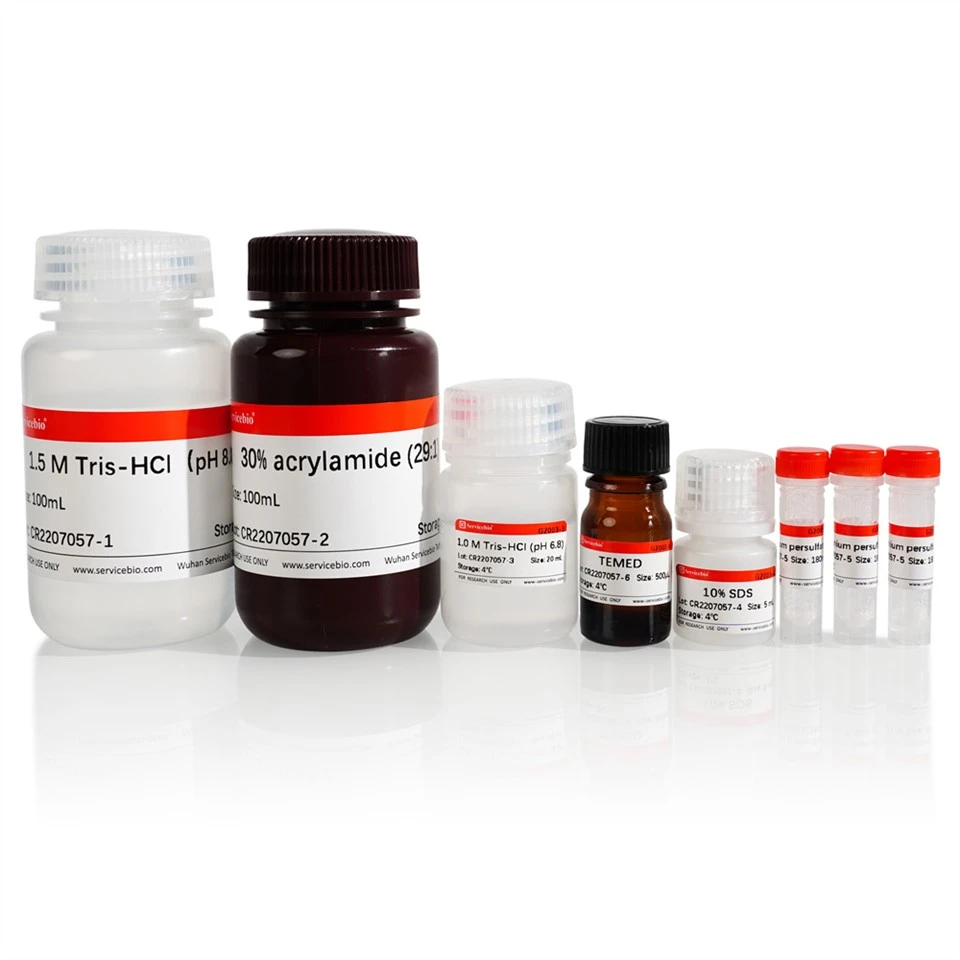
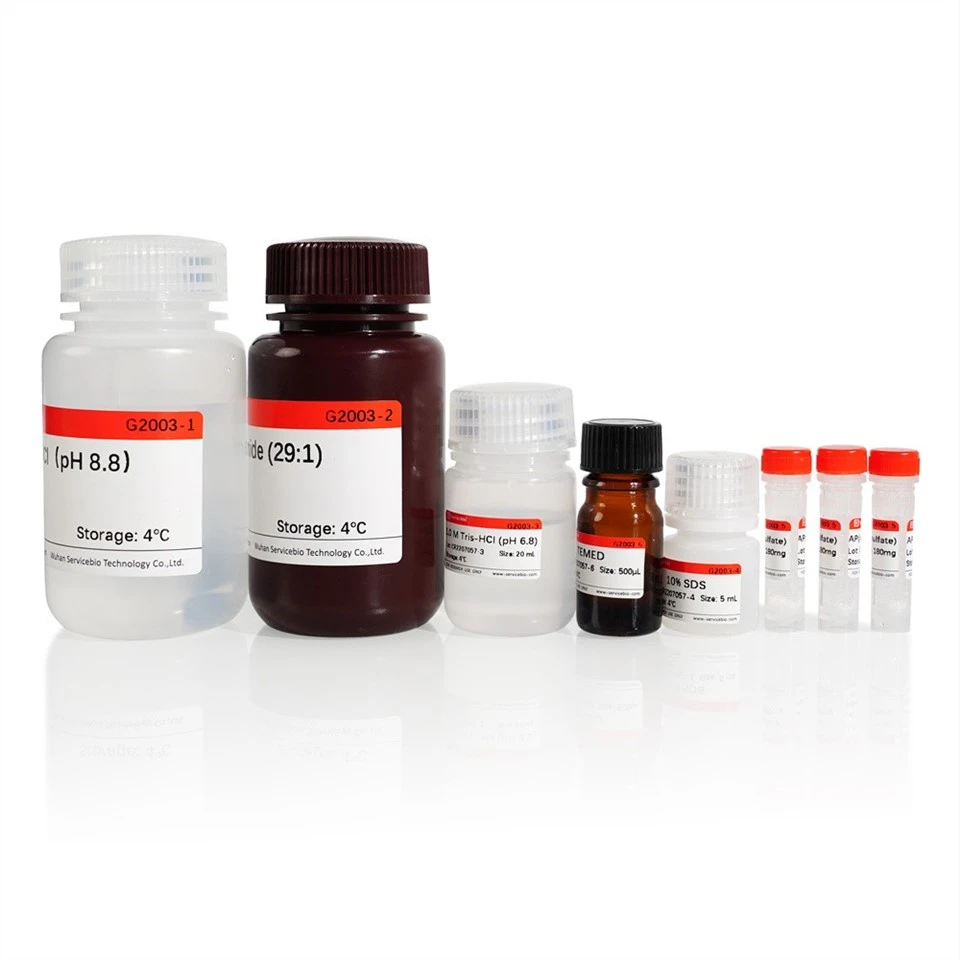
The SDS-PAGE gel preparation kit contains all reagents required for gel preparation. Users only need to prepare a small amount of pure water and gel making equipment (glue making base, glass plate, comb, etc.), and follow the instructions to produce the required gel. This kit can prepare at least 50 regular size gels.
Storage and Shipping Conditions
Ship with wet ice; Modified coagulant stored at -20℃, others stored at 2-8℃ away from light, valid for 12 months.
Production components
|
Component Number |
Component |
G2003-50T |
|
G2003-1 |
1.5 M Tris-HCl(pH 8.8) |
100 mL |
|
G2003-2 |
30% Acrylamide-Bisacrylamide (29:1) |
100 mL |
|
G2003-3 |
1.0 M Tris-HCl(pH 6.8) |
20 mL |
|
G2003-4 |
10% SDS |
5 mL |
|
G2003-5 |
PAGE gel solidification catalyst |
1 mL |
|
G5036-5ML |
Modified Coagulant |
1 mL×5 |
|
Manual |
1 pc |
|
Assay Protocol/Procedures
1. According to the molecular weight of the target protein and the selected electrophoresis buffer, select the appropriate concentration of SDS-PAGE separation gel, as shown in the table below:
|
SDS-PAGE Separation Gel Concentrations |
Optimum separation range(kDa) (Tris-Glycine electrophoresis buffer,G2018) |
Optimum separation range(kDa) (SWE Fast High Resolution Electrophoresis Buffer,G2081) |
|
6% |
50-300 |
15-300 |
|
8% |
30-130 |
10-250 |
|
10% |
20-100 |
5-150 |
|
12% |
10-60 |
3-100 |
|
15% |
<40 |
<60 |
2. According to the molecular weight of the target protein, the concentration of the separation gel was selected. Taking the common specification of 8.3 cm×7.3 cm gel plate (single block) as an example, the gel preparation solution could be prepared according to the following table:
|
Separation Gel Concentrations (%) |
6% |
8% |
10% |
12% |
15% |
||||||||||
|
Glass Plate Thickness |
0.75 mm |
1.0 mm |
1.5 mm |
0.75 mm |
1.0 mm |
1.5 mm |
0.75 mm |
1.0 mm |
1.5 mm |
0.75 mm |
1.0 mm |
1.5 mm |
0.75 mm |
1.0 mm |
1.5 mm |
|
Total volume of glue required*(mL) |
4.0 |
6.0 |
8.0 |
4.0 |
6.0 |
8.0 |
4.0 |
6.0 |
8.0 |
4.0 |
6.0 |
8.0 |
4.0 |
6.0 |
8.0 |
|
H2O(mL) |
2.1 |
3.18 |
4.24 |
1.85 |
2.78 |
3.7 |
1.59 |
2.38 |
3.17 |
1.32 |
1.98 |
2.64 |
0.92 |
1.38 |
1.84 |
|
30% Acrylamide-Bisacrylamide (29:1) (mL) |
0.8 |
1.2 |
1.6 |
1.07 |
1.6 |
2.14 |
1.33 |
2.0 |
2.67 |
1.6 |
2.4 |
3.2 |
2.0 |
3.0 |
4.0 |
|
1.5 M Tris-HCl(pH 8.8)(mL) |
1.0 |
1.5 |
2.0 |
1.0 |
1.5 |
2.0 |
1.0 |
1.5 |
2.0 |
1.0 |
1.5 |
2.0 |
1.0 |
1.5 |
2.0 |
|
10% SDS(μL) |
40 |
60 |
80 |
40 |
60 |
80 |
40 |
60 |
80 |
40 |
60 |
80 |
40 |
60 |
80 |
|
Modified Coagulant ( μL ) |
40 |
60 |
80 |
40 |
60 |
80 |
40 |
60 |
80 |
40 |
60 |
80 |
40 |
60 |
80 |
|
PAGE gel solidification catalyst(μL) |
4.0 |
6.0 |
8.0 |
4.0 |
6.0 |
8.0 |
4.0 |
6.0 |
8.0 |
4.0 |
6.0 |
8.0 |
4.0 |
6.0 |
8.0 |
* The total volume of the gel preparation solution does not include the volume of PAGE gel solidification catalyst
3. The preparation of stacking gel can refer to the following table:
|
Stacking Gel Concentrations(%) |
5% |
|||
|
H2O(mL) |
1.93 |
2.95 |
3.86 |
5.79 |
|
30% Acrylamide-Bisacrylamide (29:1) (mL) |
0.5 |
0.75 |
1.0 |
1.5 |
|
1.0M Tris-HCl(pH 6.8)(mL) |
0.5 |
0.75 |
1.0 |
1.5 |
|
10% SDS(μL) |
40 |
60 |
80 |
120 |
|
Modified Coagulant(μL) |
18 |
27 |
36 |
54 |
|
PAGE gel solidification catalyst(μL) |
4 |
6 |
8 |
12 |
|
Total volume*(mL) |
3 |
4.5 |
6.0 |
9.0 |
* The total volume does not include the PAGE gel solidification catalyst volume.
4. Recommended electrophoretic conditions:
a) Using SWE fast high-resolution electrophoresis buffer (G2081) for electrophoresis: 200-250 V constant pressure, 25-35 min to complete the electrophoresis;
b) Tris-Glycine electrophoresis buffer (G2018) is used for electrophoresis: the voltage of the upper gel is set at 90 V, and electrophoresis lasted for about 30 min (marker entered the separating gel); The adjustment voltage of the lower gel is 150-180 V, about 60-90 min (can be adjusted according to the actual situation).
Note
1. All reagents should be rewarmed to room temperature before use.
2. Compared to ammonium persulfate (AP), the improved coagulant has better stability. Take out one for use and store it at 4℃ after use for subsequent routine use, which can be stored for six months. If not used for a long time, please store it at -20℃ to avoid repeated freezing and thawing.
3. Tricine gel is recommended for protein separation smaller than 10 kDa; acrylamide gels may not be sufficient for separation.
4. Temperature has a significant impact on the gelation time of the adhesive. To ensure smooth experiment progress, generally, lower temperatures result in longer gelation times, and it may be necessary to increase the dosage of the modified coagulant accordingly. On the other hand, higher temperatures lead to faster gelation, so the dosage of the modified coagulant can be reduced accordingly.
5. The gel needs sufficient solidification time, and it is recommended that the gel be fully prepared and left to ensure that the it gels thoroughly.
6. When the temperature is low, 10% SDS solution has crystallization precipitation, and can be used after remelting at 37℃.
7. If you need a fast gel preparation set of reagents, you can buy other products of our company, such as SDS-PAGE Fast Acrylamide Kit (G2037), or super-fast color gel preparation kit series (G2041 / G2042 / G2043 G2044 / G2045 / G2060 / G2061 / G2062 / G2063 / G2064), And high resolution ultra-fast color gel preparation kit series (G2066/G2067/G2068, G2071/G2072/G2073), can meet different experimental needs.
8. For your safety and health, please wear a lab coat and disposable gloves when operating.
For Research Use Only!

