
Product Introduction
|
Product Name |
Cat.No. |
Spec. |
|
Von Kossa Staining Solution |
G1043-20ML |
3×20 mL |
Description
This product is Von Kossa dye solution for calcium salt staining in tissues. Von Kossa staining is a classic method of staining mineralized nodules. The basic principle is that silver nitrate and insoluble calcium salts form reducible silver salts in situ through metathesis. Then under the action of strong light or ultraviolet light or strong reducing agent, the silver salt is reduced to black elemental silver to realize the color development of calcium salt in the tissue. It is suitable for the samples with more calcium salt deposition.
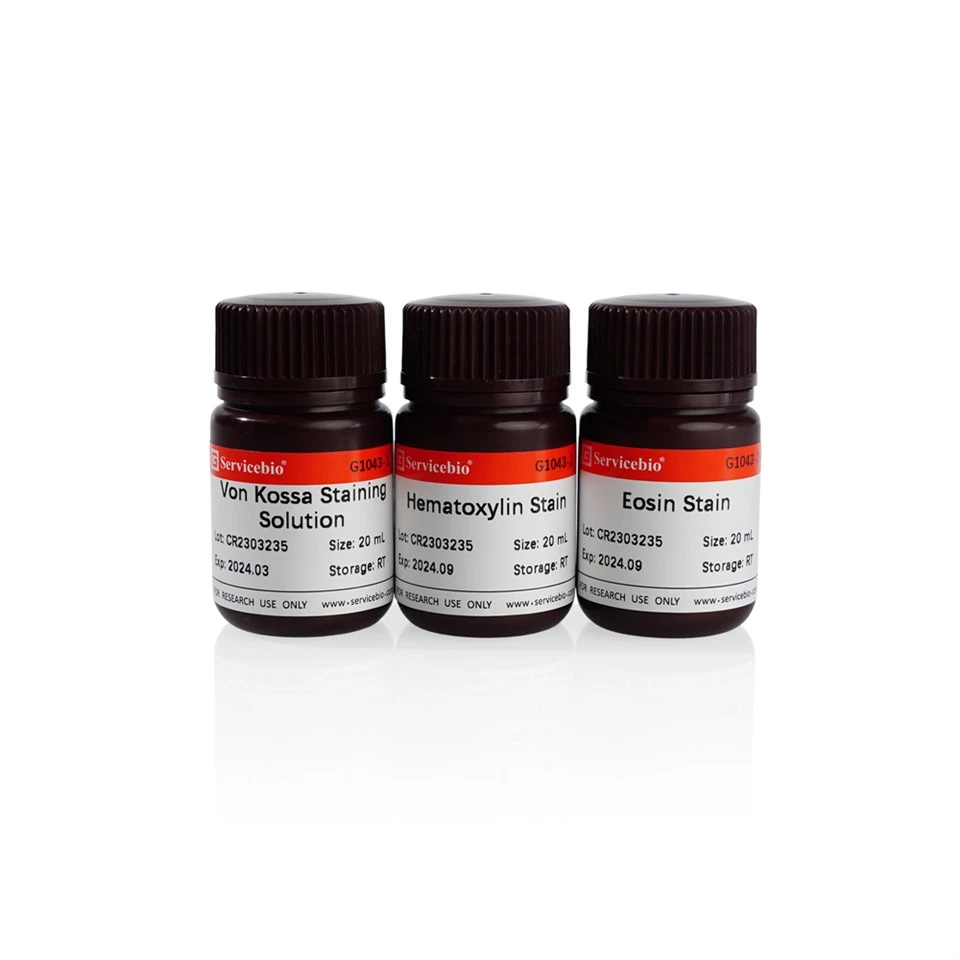
This product is a set containing cell nucleus and cytoplasm counterstaining solution, in which Von Kossa staining solution is XSY solution. After staining, the calcium salt deposit area is black, the nucleus is blue, and the background is light red.
Storage and Handling Conditions
Store and transport at room temperature; valid for 12 months.
Component
|
Component Number |
Component |
G1043-20ML |
|
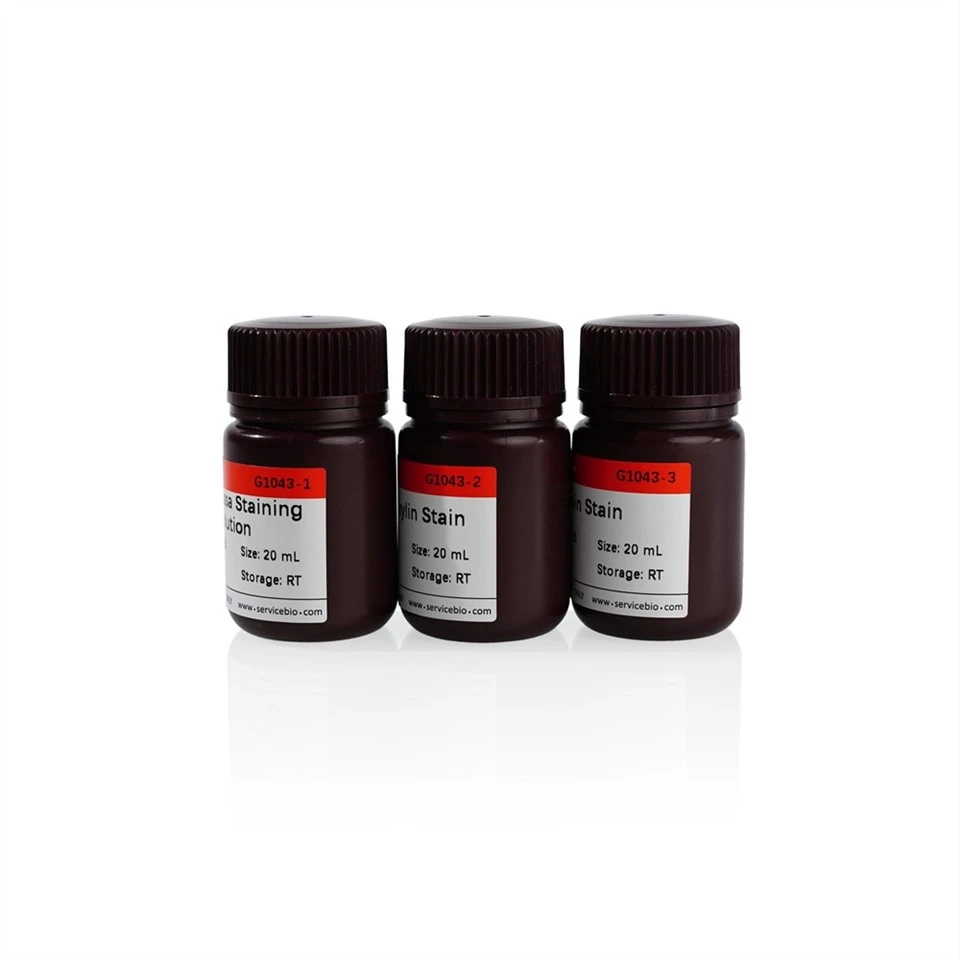
G1043-1 |
Von Kossa Solution |
20 mL |
|
G1043-2 |
Hematoxylin Solution |
20 mL |
|
G1043-3 |
Eosin Solution |
20 mL |
|
Product Manual |
||
Assay Protocol
1. Paraffin sections were successively dewaxed by xylene for 10 min, replaced by fresh xylene for 10 min, absolute ethanol for 5min, fresh absolute ethanol for 5min, 90% ethanol for 5min, 75% ethanol for 5min, and then immersed and washed with ultra-pure water for 5 times.
2. The tissue was circled with a tissue chemical pen, and the sections were placed in a transparent wet box, and Von Kossa dye solution was added to the sections to cover the tissue, capped, and the wet box was placed smoothly under ultraviolet light for 4 h. Note: If it is a high power UV lamp, irradiation time can be shortened accordingly. Here 4 h irradiation with ordinary ultra-clean table UV lamp.
3. Wash Von Kossa dye with ultrapure water (must be rinsed), remove sections immediately, soak in ultrapure water for 3 times, and rinse with running water for 2 min.
4. Restaining: Sections were stained with hematoxylin dye solution for 3-5 min, washed with tap water, differentiated solution (recommended G1039) differentiated, washed with tap water, bluing solution (recommended G1040) returned to blue, washed with running water, and dehydrated with 85% and 95% alcohol gradient for 5 min each. The sections were stained with eosin solution for 5 min and dehydrated with absolute ethanol twice for 5 min each. Then the sections were dehydrated with fresh absolute ethanol for 5 min, transparent with xylene for 5 min, and transparent with fresh xylene for 5 min. Add drops of neutral gum to seal the slices.
Note: Prepare differentiation solution, bluing solution, xylene, gradient ethanol, neutral gum, etc.
Note
1. Before and after Von Kossa staining droplets, the sections were immersed in ultrapure water to avoid ionic impurities in the water interfering with the staining results.
2. If there is no ultraviolet lamp, you can also use strong sunlight irradiation, pay attention to adjust the irradiation time.
3. Each set of staining solution can be used to stain approximately 20 sections. One of the Von Kossa stains is not reusable and requires drop staining. Hematoxylin and eosin stains are dip-stained and can be reused.
4. This product is not suitable for decalcified tissues and tissues with less calcium salt deposition. Alizarin Red S staining (G1038) is recommended for tissues with low calcium salt deposition.
For Research Use Only!


