
Product Introduction
|
Product Name |
Cat.No. |
Spec. |
|
Plant RNA Kit For Polysaccharides & Polyphenolics |
G3641-50T |
50T |
Product Description/Introduction
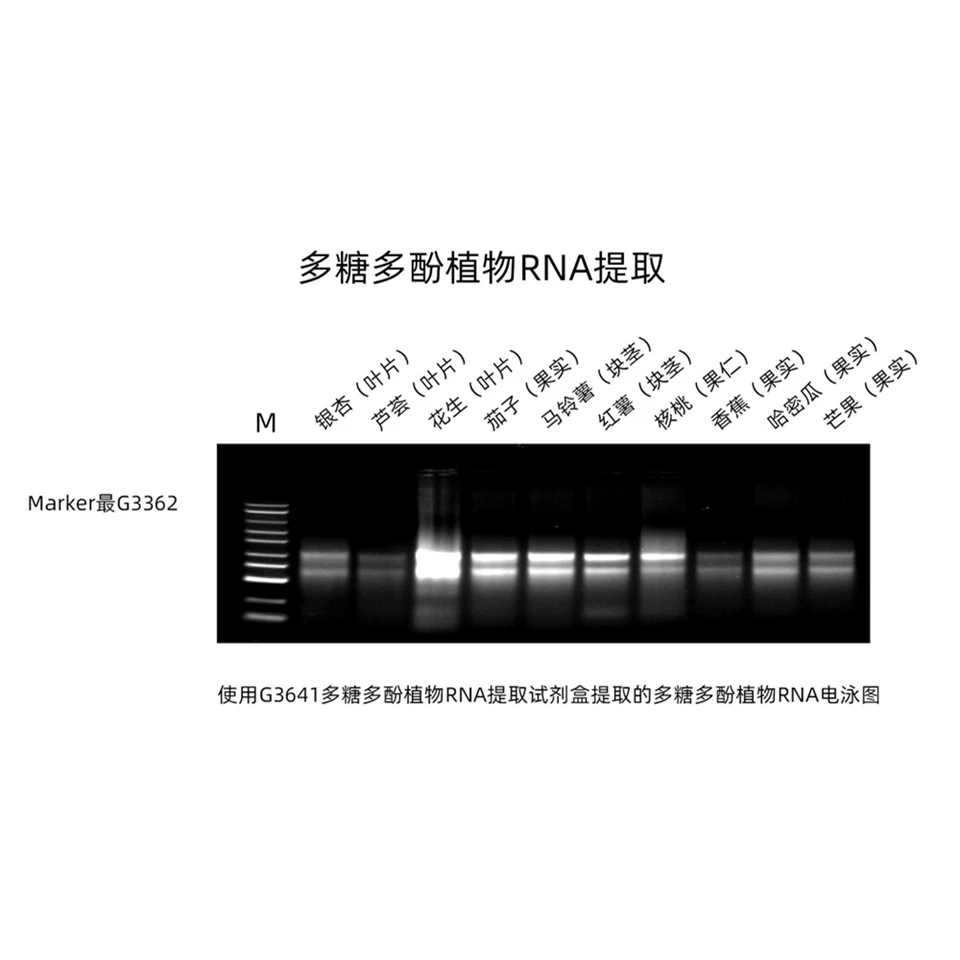
This kit can extract RNA from various plant tissue samples (such as leaves, seeds, fruits, etc.) rich in polysaccharides and polyphenols by using a special lysis buffer system combined with silica gel membrane purification method. This kit can effectively remove polysaccharides, polyphenols, proteins, cell fragments and other impurities in plant tissue samples, and can purify up to tens of micrograms of high-purity and high-integrity RNA from 20-200 mg plant tissue sample within one hour. No organic reagents such as phenol and chloroform are required. The high purity RNA extracted can be directly used in various molecular biology experiments such as Northern hybridization, spot hybridization, mRNA purification, in vitro translation, RT-PCR, RT-qPCR, cDNA library construction, etc.
Storage and Handling Conditions
DNase, DTT Solution is transported in wet ice and stored at -20°C; The remaining reagents are transported and stored at room temperature; The expiration date is 12 months.
Product Contents
|
Component Number |
Component |
G3641-50T |
|
G3641-1 |
Buffer PRL1 |
30 mL |
|
G3641-2 |
Buffer PRL2 |
8 mL |
|
G3641-3 |
Buffer PRL3 |
30 mL |
|
G3641-4 |
Buffer RWA |
18 mL |
|
G3641-5 |
Buffer RWB |
20 mL |
|
G3641-6 |
DTT Solution |
1.2 mL |
|
G3641-7 |
DNase |
250 μL |
|
G3641-8 |
10×DNase Buffer |
500 μL |
|
G3641-9 |
Nuclease-free Water |
10 mL |
|
G3641-10 |
RNA Spin Columns(with Collection Tubes) |
50 sets |
|
Manual |
One copy |
|
Before starting (please read carefully)
1. If Buffer PRL1 precipitates, please heat it at 37°C and use it when it is restored to room temperature.
2. Before use, please add DTT Solution to Buffer PRL3 until the final concentration is 4%, that is, add 40 µL DTT Solution to 1 mL Buffer PRL3. This lysate is best prepared fresh, Buffer PRL3 added to DTT Solution can be stored at 4℃ for one month.
3. Before use, please add 12 mL absolute ethanol to Buffer RWA and 80 mL absolute ethanol to Buffer RWB.
4. When grinding with the grinder, precool the grinder in advance.
Assay Protocol / Procedures
1. Lysis of plant tissues:
a. For plant leaves, the recommended sampling volume is 50-100 mg. Transfer fresh or cryopreserved plant tissue to a 2.0 mL Nuclease-free grinding tube (recommended HT-200-M) containing 3-4 3 mm zirconia beads (recommended G0203-150G) and pre-cooled with liquid nitrogen. Place the grinding tube on the grinder (recommended KZ-5F-3D) (quickly precool the adapter in liquid nitrogen before placing the grinding tube. Recommended grinding procedure: set the frequency to 60 HZ, temperature to 4℃,grind for 30 seconds each time, repeating the process 4 times, with a 5 second interval between each grind) and grind until it is completely powdered (If the tissue is not completely ground to powder, it will affect the yield and quality of RNA. The grinding times can be extended until the tissue is fully ground). Once the grinding is completed, add 500 μL Buffer PRL1 to the grinding tube, mix the contents upside down and incubate at 56°C for 15 min, mixing upside down every 5 min.
b. For plant seeds, the recommended sampling volume is 20-50 mg, and 100-200 mg for fruits. Add 500 μL Buffer PRL1 to a 2.0 mL Nuclease-free grinding tube (recommended HT-200-M) in advance, and then add 3-4 4 mm steel beads (recommended G0104-200G). Transfer fresh or cryopreserved plant tissue to the 2.0 mL Nuclease-free grinding tube. Place the grinding tube on the grinder (recommended KZ-5F-3D) (Recommended grinding procedure: set the frequency to 70 HZ, temperature to 4℃,grind for 30 seconds each time, repeating the process 20-30 times, with a 5 second interval between each grind) and grind until it is completely until it is homogenised (If the tissue is not completely ground to homogenate, it will affect the yield and quality of RNA. The grinding times can be extended until the tissue is fully ground). Once the grinding is completed, incubate at 56°C for 15 min, mixing upside down every 5 min.
2. Centrifuge at 12,000 rpm for 5 min at room temperature, transfer the supernatant to a new 1.5 mL centrifuge tube. Add 1/5 supernatant volume of Buffer PRL2, fully upside down and mix well.
3. Centrifuge at 12,000 rpm for 5 min at 4℃, transfer the supernatant to a new 2.0 mL centrifuge tube. Add 500 μL Buffer PRL3 to the supernatant (make sure you have added DTT Solution before use), fully upside down and mix well.
4. Add 1/2 volume of isopropanol to the mixture from the previous step, fully upside down and mix well.
5. Transfer the mixture to RNA Spin Column. Each addition does not exceed 600 μL, if exceeds, it can be added in batches.
6. Centrifuge at 12,000 rpm for 1 min at room temperature, and discard the filtrate. Put the RNA Spin Column back into the Collection Tube.
7. Add 500 μL Buffer RWA to RNA Spin Column, and centrifuge at 12,000 rpm for 1 min at room temperature, then discard the filtrate.
8. Add 600 μL Buffer RWB to RNA Spin Column (please add Buffer RWB along the pipe wall to help flush the residual salt on the pipe wall), and centrifuge at 12,000 rpm for 1 min at room temperature, then discard the filtrate.
9. DNase digestion:
a) preparation of DNase reaction solution: Mix 5 μL 10 × DNase Buffer, 5 μL DNase, 40 μL Nuclease-free Water in a new 1.5 mL Nuclease-free centrifuge tube;
b) add 50 μL DNase reaction solution to the center of RNA Spin Column, and stand at room temperature at 15 min;
c) add 500 μL Buffer RWB to RNA Spin Column, and centrifuge at 12,000 rpm for 30 s at room temperature, then discard the filtrate. Put the RNA Spin column back into the collection tube.
10. Repeat step 8.
11. Put RNA Spin Column into the collection tube, centrifuge at 12,000 rpm for 2 min at room temperature to remove the residual liquid.
12. Transfer RNA Spin Column to a new 1.5 mL Nuclease-free centrifuge tube, stand at room temperature for 3~5 min, so that the residual ethanol of RNA Spin Column can be evaporate completely.
13. Add 50-100 μL Nuclease-free Water to the center of RNA Spin Column, stand at room temperature for 5 min. Centrifuge at 12,000 rpm for 2 min at room temperature to collect RNA. To get a higher concentration of RNA, you can also add the first eluent back to RNA Spin Column, then stand at room temperature for 5 min and centrifuge at 12,000 rpm for 2 min at room temperature to collect RNA again.
Note
1. Please wear a lab coat and disposable gloves when operating.
2. Use RNase-free plastic products and tips to avoid cross-contamination.
3. Use special test bench and electrophoresis equipment for RNA operation, and wear a mask during operation to prevent the utensils and reagents used from being RNase pollution.
4. If plant samples are collected outside the laboratory, the samples should be placed in liquid nitrogen to avoid affecting the yield and quality of RNA.
5. For the samples with more water content, the initial sample size can be increased appropriately.
Schedule
The RNA yield extracted from a variety of plant and fungus sample by this kit is shown in the table below. RNA yield is related to plant species, organs, freshness and growth status. The following table is for reference only.
|
Sample type |
Sample name |
RNA yield |
|
Leaf |
Gossypium hirsutum |
40-45 μg/80 mg |
|
Rosa chinensis |
50-60 μg/50 mg |
|
|
Pinus |
5-8 μg/50 mg |
|
|
Bryophyllum pinnatum |
5-8 μg/150 mg |
|
|
Seed |
Arachis hypogaea |
15-20 μg/50 mg |
|
Triticum aestivum |
5-8 μg/50 mg |
|
|
Brassica napus |
20-25 μg/20 mg |
|
|
Gossypium hirsutum |
20-25 μg/20 mg |
|
|
Fruit |
Lycopersicon esculentum |
20-25 μg/150 mg |
|
Tuber |
Solanum tuberosum |
10-13 μg/200 mg |
For Research Use Only!


