
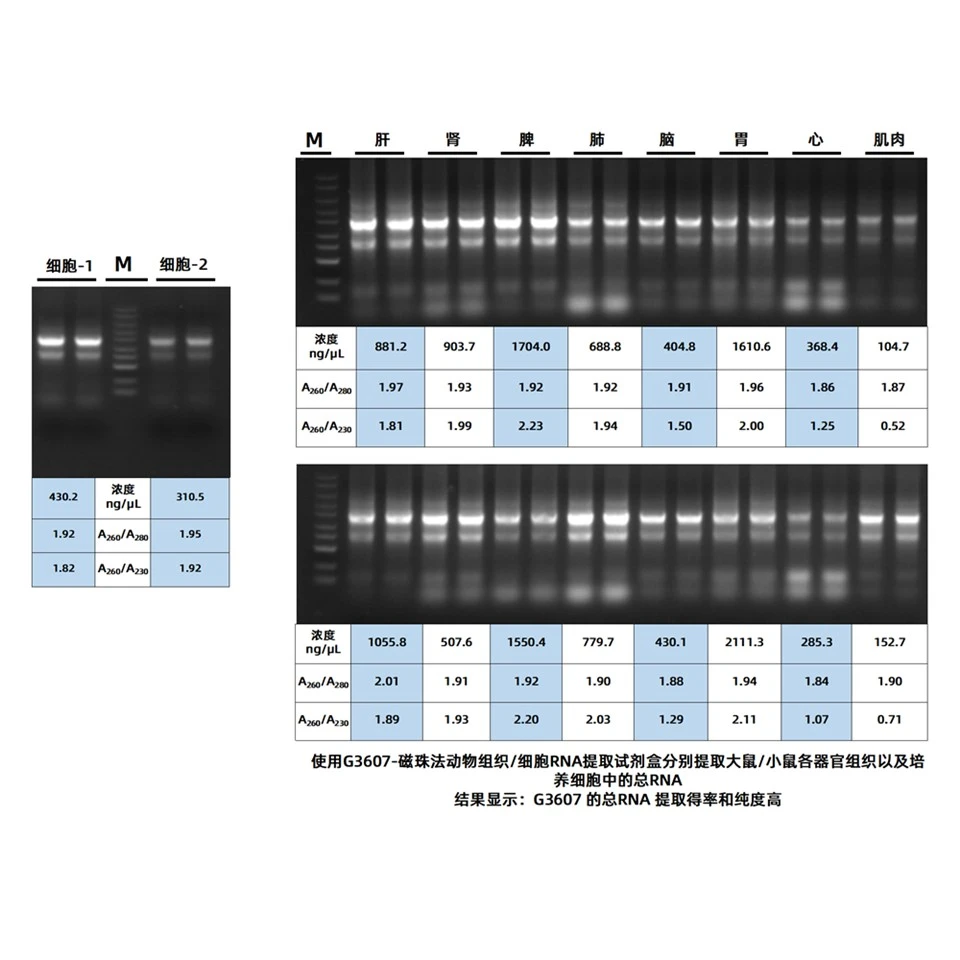
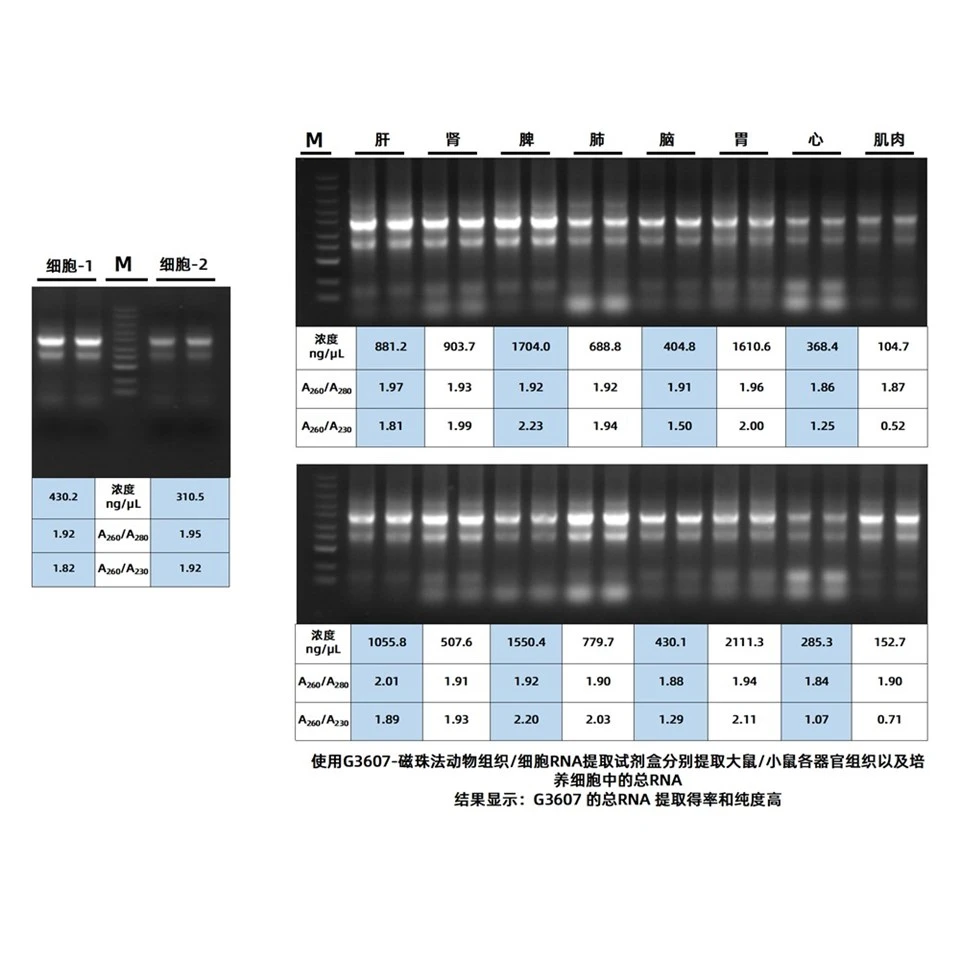
Product Introduction
|
Product Name |
Cat. No. |
Spec. |
|
MagBind Animal Tissue/Cell Total RNA Kit |
G3607-50T |
50 T |
Description/Introduction
This kit releases nucleic acids from animal tissues or cultured cells through a specially optimized lysis buffer, and then specifically binds total RNA from animal tissues or cultured cells through superparamagnetic magnetic beads specially designed for binding RNA, which are rinsed to remove residual impurities on the surface of the beads, and then finally eluted to obtain high-purity RNA. This kit eliminates the need for organic reagents such as phenol and chloroform, has a short magnetization time, is simple to operate, and requires no multi-step centrifugation, and allows for the rapid extraction of high-purity RNA from 5-20 mg of animal tissue or freshly cultured cells (106-107). The extracted RNA can be directly used in various molecular biology experiments such as RT-PCR, RT-qPCR, Northern Blot, in vitro translation, RNase protection assay and molecular cloning.
Storage and Shipping Conditions
Proteinase K, DNase and DTT Solution are shipped with wet ice, stored at -20℃; Other reagents are shipped and stored at room temperature; valid for 12 months.
Product Contents
|
Component Number |
Component |
G3607-50T |
|
G3607-1 |
Buffer RL |
30 mL |
|
G3607-2 |
Buffer RW1 |
12 mL(Add 18 mL of anhydrous ethanol before use) |
|
G3607-3 |
Buffer RW2 |
18 mL(Add 72 mL of anhydrous ethanol before use) |
|
G3607-4 |
SweMag Beads |
1 mL |
|
G3607-5 |
DTT Solution |
1.2 mL |
|
G3607-6 |
Proteinase K |
500 μL |
|
G3607-7 |
DNase |
500 μL |
|
G3607-8 |
10×DNase Buffer |
1 mL |
|
G3607-9 |
Nuclease-free Water |
12 mL |
|
Manual |
One copy |
|
Before Starting (please read carefully)
1. If a precipitate has formed in Buffer RL, warm it at 37°C until the precipitate has fully dissolved. Use it after cooling down to room temperature.
2. Before operation, add appropriate volume of DTT Solution into Buffer RL1 to a final concentration of 4% ( Add 40 μL DTT Solution per 1 mL of Buffer RL1. It should be prepared immediately before use. This mixture can be stored at 4℃ for one month.)
3. Add the specified amount (see bottle) of anhydrous ethanol to Buffer RW1 and Buffer RW2 before use.
4. Prepare 60% isopropyl alcohol (ready to use) in advance according to the amount of sample extracted.
5. Please pre-cool the grinder if grinding tissue with a grinder.
6. Provide your own magnetic stand and 1.5 mL RNase-free centrifuge tubes.
Assay Protocol / Procedures
1. Samples preparation:
a. Animal tissue homogenate:
Take out fresh or frozen tissue at -80°C or animal tissue preserved in RNAsolid Tissue RNA Stabilization Solution (G3019 is recommended), place them in a 1.5 mL centrifuge tube or special grinding tube containing 2-3 grinding beads with a diameter of 3 mm (G0203-150G recommended). Immediately add 500 uL of Buffer RL1 prepared with DTT solution to your sample. Thoroughly grind the tissue to homogenization (if the tissue is not thoroughly homogenized, the yield and quality of RNA will be affected) using a Tissue Homogenizer (KZ-5F-3D recommended) at low temperature, add 10 µL of Proteinase K, mix well, and then incubate at 56°C for 10-15 min and centrifuge at 12,000 rpm for 5 min at 4°C.
b. Suspension cells
Transfer the suspension culture cells together with the culture medium into a 1.5 mL RNase-free centrifuge tube, centrifuge at 1,000 rpm for 5 min, collect the suspension culture cells (106-107), gently aspirate and discard the supernatant, add 500 μL of Buffer RL1 to the cell precipitate (make sure that the DTT Solution has been added before use), and pipette and blow evenly until there is no obvious precipitate. Then add 10 µL Proteinase K, mix well and incubate at 56℃ for 10-15 min, centrifuge at 12,000 rpm and 4℃ for 5 min.
c. Adherent cells
d. Remove the growth medium from the cells and then wash with 1×PBS buffer(pH 7.4). Add appropriate amount of Buffer RL1 to the cultured cells (please make sure that DTT Solution has been added before use), place the dish horizontally so that the lysate is evenly distributed on the surface of the cells and lyses the cells, and then gently blow with a pipette to dislodge the cells completely, transfer 500 μL of the lysate containing the cells to 1.5 mL RNase-free centrifuge tubes respectively, and then 10 µL of Proteinase K was added, mixed well and incubated at 56°C for 15 min, centrifuged at 12,000 rpm at 4°C for 5 min.
2. Transfer the supernatant to a new 1.5 mL RNase-free centrifuge tube.
Note: Do not pipet any Precipitation.
3. Add an equal volume of 60% isopropanol to the centrifuge tube (precipitation may occur at this point), mix by pipetting or vortexing, then add 20 μL of SweMag Beads (SweMag Beads need to be shaken well before use until well dispersed), mix by pipetting or vortexing.
4. Let the beads stand at room temperature for 10 min, and during the process, use a pipette to blow and mix several times to keep the beads in suspension.
5. Transfer the centrifuge tube to a magnetic stand and let it stand for 30 s. When the supernatant is clear, aspirate and discard the supernatant.
6. Add 500 μL of Buffer RW1, remove the magnetic stand, use a pipette to blow until the magnetic beads are well dispersed, transfer the centrifuge tube to the magnetic rack and let it stand for 30 s. When the supernatant is clear, aspirate and discard the supernatant.
7. Add 500 μL of Buffer RW2, remove the magnetic stand, use a pipette to blow until the magnetic beads are well dispersed, transfer the centrifuge tube to the magnetic stand and let it stand for 30 s. When the supernatant is clear, aspirate and discard the supernatant.
8. Remove the centrifuge tube from the magnetic stand for DNase digestion:
a. Prepare DNase working solution:Take 10 μL of 10×DNase Buffer, 10 μL of DNase, 80 μL of Nuclease-free Water and mix well in a new Nuclease-free centrifuge tube.
b. Add 100 µL DNase I working solution to the tube containing the pelleted magnetic beads, and pipet up and down gently to resuspend the magnetic beads. Stand at room temperature for 15 minutes and mix well with every 5 min during incubation.
9. After DNase digestion, add 500 µL of Buffer RW2 and pipet up and down gently to resuspend the magnetic beads. And then place the tube on a magnetic stand for 30 seconds. When the magnetic beads are completely attached, carefully discard the supernatant with a pipette
10. Repeat step 9.
11. Open the centrifuge tube lid, place it at room temperature for 5-10 minutes to ensure complete evaporation of residual ethanol. (Avoid over-drying of the beads to avoid affecting the nucleic acid yield.)
12. Remove the magnetic stand, add 50–100 μL Nuclease-free Water and pipet up and down gently to resuspend the magnetic beads, stand at room temperature for 5 minutes.
13. Place the centrifuge tube on a magnetic stand until the magnetic beads are fully adsorbed and aspirate the supernatant into a new 1.5 mL RNase-free centrifuge tube to obtain high purity RNA.
Note
1. Please read the Product Manual carefully before use.
2. Magnetic bead suspension should avoid freezing during storage; magnetic beads are easy to settle, and should be fully shaken to keep them in uniform suspension before use.
3. Before adding magnetic beads to the sample, the reagents in the sample need to be mixed well.
4. The ethanol should be completely volatilized before eluting RNA to avoid residual ethanol affecting downstream experiments.
5. Do not dry the beads for a long time as this may affect the RNA elution efficiency.
14. For your safety and health, please wear safety glasses, gloves, or protective clothing. Wear a mask, avoid talking, and use RNase-free tips and centrifuge tubes to avoid cross-contamination.
For Research Use Only!


