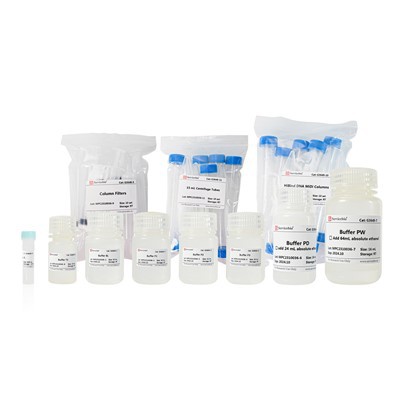
Product Introduction
|
Product Name |
Cat. No. |
Spec. |
|
MagBind FFPE DNA Extraction Kit |
G3605-50T |
50 T |
Description/Introduction
The MagBind FFPE DNA Extraction Kit uses a unique dewaxing reagent, which can efficiently remove wax clumps around paraffin-embedded tissues, avoiding the use of toxic reagents such as xylene. By effectively releasing genomic DNA from tissues with a specially optimized lysis buffer and by taking advantage of the specific binding of genomic DNA by super-conformal magnetic beads, genomic DNA from tissues can be extracted quickly and efficiently. The genomic DNA obtained is large in volume and high in purity, and could be applied in PCR, Real-time PCR, SNP genotype analysis and other molecular biology experiments.
Storage and Shipping Conditions
RNase A and Proteinase K are shipped with wet ice, stored at -20℃; Other reagents are shipped and stored at room temperature; valid for 12 months.
Product Contents
|
Component Number |
Component |
G3605-50T |
|
G3605-1 |
Buffer DP |
30 mL |
|
G3605-2 |
Buffer GL |
10 mL |
|
G3605-3 |
Proteinase K |
1 mL |
|
G3605-4 |
RNase A |
500 uL |
|
G3605-5 |
Buffer GB |
10 mL |
|
G3605-6 |
SweMag Beads |
1.5 mL |
|
G3605-7 |
Buffer GP |
9 mL (21 mL of anhydrous ethanol added before use) |
|
G3605-8 |
Buffer PW |
24 mL (56 mL of anhydrous ethanol added before use) |
|
G3605-9 |
Buffer TE |
10mL |
|
Manual |
One copy |
|
Before Starting (please read carefully)
1. Please prepare water or metal baths at 80°C, 56°C and 90°C in advance.
2. If a precipitate has formed in Buffer GL or Buffer GB, warm it at 65°C to dissolve and allow to return to room temperature before use.
3. Before use, add 21 mL of absolute ethanol to Buffer GP, add 56 mL of absolute ethanol to Buffer PW and mix well separately then use.
4. Magnetic stands and isopropanol are required but not supplied in this kit.
Assay Protocol / Procedures
1. Samples preparation:
a. Paraffin section: take 5-8 pieces of paraffin sections (surface area of 1x1 cm2), scrape with a sterilized scalpel and collect tissue fragments, place in 1.5 mL centrifuge tubes.
b. Paraffin block: use a sterilized scalpel to cut around 30 mg tissue sample (trim excess paraffin off the sample block) and place in 1.5 mL centrifuge tubes..
c. Samples embedded in formalin: suck up the liquid on the surface of the tissue with filter paper, cut about 30 mg sample into pieces, and place in a 1.5 ml centrifuge tube. Add 500 µL of PBS (10 mM, pH 7.4), vortex to mix for 10 s, then centrifuge at 12,000 rpm for 1 minute at room temperature, discard the supernatant. Repeatly wash three times.
2. Add 500 μL of Buffer DP to a 1.5 mL centrifuge tube containing the sample, incubate at 80℃ for 3 minutes, immediately vortex for 10 s.
3. Add 200 μL of Buffer GL to a centrifuge tube, vortex to mix, and centrifuge at 12,000 rpm for 1 minute at room temperature (The solution forms two layers :the upper layer -the oil phase and the lower layer -the aqueous phase).
4. Add 20 μL of Proteinase K and 10 μL of RNase A to the lower aqueous phase, gently pipette and mix well (try not to break the layer) and incubate at 56℃ for 20 minutes.
5. Subsequently, the centrifuge tube is transferred to 90°C and incubated for 10 min(If there are more unlysed tissue pieces, the incubation time could be extend to 20 minutes),cool to room temperature.
6. Add 200 µL of Buffer GB and 200 μL of isopropanol to the sample from the previous step, and mix thoroughly by vortex.
7. Centrifuge at 12,000 rpm for 1 minute at room temperature, the solution forms two layers (the upper layer -the oil phase and the lower layer -the aqueous phase).
8. Transfer carefully the aqueous layer solution to a new 1.5 mL centrifuge tube (Do not pipet the upper oil phase solution and other impurities), add 30 μL of SweMag Beads to the centrifuge tube (SweMag Beads must be fully resuspended and evenly distributed prior to use), and mix well with pipette until the beads are well dispersed.
9. Stand at room temperature for 5 minutes and mix well with pipette 2-3 times to help SweMag Beads evenly distributed.
10. Place the centrifuge tube on a magnetic stand for 30 seconds, so that the magnetic beads are adsorbed to the wall of the tube. When the supernatant is clear, carefully discard the supernatant with a pipette (To avoid lower recovery rate, do not aspirate the magnetic beads).
11. Remove the tube containing the pelleted magnetic beads from the magnetic stand, add 500 µL of Buffer GP and pipet up and down gently to resuspend the magnetic beads. And then place the tube on a magnetic stand for 30 seconds, so that the magnetic beads are adsorbed to the wall of the tube. When the supernatant is clear, carefully discard the supernatant with a pipette (To avoid lower recovery rate, do not aspirate the magnetic beads).
12. Remove the tube containing the pelleted magnetic beads from the magnetic stand, add 600 µL of Buffer PW and pipet up and down gently to resuspend the magnetic beads. And then place the tube on a magnetic stand for 30 seconds, so that the magnetic beads are adsorbed to the wall of the tube. When the supernatant is clear, carefully discard the supernatant with a pipette (To avoid lower recovery rate, do not aspirate the magnetic beads).
13. Repeat step 12.
14. Open the centrifuge tube lid, place it at 65℃ for 3-5 minutes or leave it at room temperature for 5-10 minutes to ensure complete evaporation of residual ethanol. (Do not allow them to dry out as this may affect the nucleic acid yield)
15. Remove the centrifuge tube from the magnetic stand, add 50–80 μL of Buffer TE or Nuclease-free Water and pipet up and down gently to resuspend the magnetic beads, stand at room temperature for 3 minutes.
16. Place the tube on a magnetic stand until the magnetic beads are fully adsorbed, then aspirate the supernatant into a new centrifuge tube to obtain high purity genomic DNA.
Note
1. Please read the Product Manual carefully before use.
2. The DNA yield and integrity of the DNA fragment extracted from this kit depends on the sample type, fixed time, fixed conditions, and sample storage time. The fixation time should preferably be within 8-24 h. If the samples are fixed for more than 24 h or stored for more than 1 year, it will result in too much DNA fragmentation to amplify the target bands.
3. Thoroughly dehydrate samples prior to embedding to prevent residual formalin from affecting subsequent experiments.
4. TEmbedded tissue should be sampled by removing as much excess paraffin as possible and chopping the sample, and the amount of sample should not be more than 30 mg, otherwise it is easy to cause incomplete lysis, which affects the nucleic acid yield.
5. Magnetic beads are prone to precipitation and should be shaken or vortexed to mix well before use. Magnetic bead suspensions should be stored in such a way as to avoid freezing.
6. Ethanol should completely evaporate before plasmid DNA elution due to residual ethanol affecting downstream experiments. Please do not dry the beads for a long time to avoid affecting the efficiency of genomic DNA elution.
7. When the purified DNA as a PCR amplification template, it is recommended to do a template concentration gradient test first to select the optimal template concentration for amplification.
8. For your safety and health, please wear safety glasses, gloves, or protective clothing.
For Research Use Only!