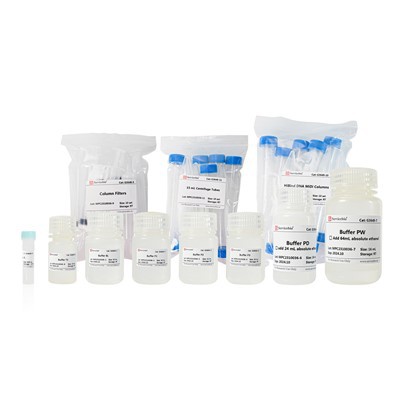
Product Introduction
|
Product Name |
Cat.No. |
Spec. |
|
DNase Residue Detection Kit |
G3057-100T |
100T |
Description/Introduction
Deoxyribonuclease (DNase) and ribonuclease (RNase) are a class of hydrolytic enzymes that degrade DNA and RNA molecules, which widely exist in the environment, reagents (such as enzymes) and biomaterials (such as PCR reaction tubes). The trace residue of nuclease can degrade a large number of nucleic acids, which has a certain impact on downstream biological experiments. Therefore, regular nuclease residue testing of reagents, consumables and containers in biological laboratories is necessary.
The kit is a fluorescent probe-based high-sensitivity DNase rapid assay,and it contains a unique DNA modified substrate (DNase Substrate) with a fluorescence group and a quenching group at both ends, respectively. The excitation/emission wavelength of the fluorescence group is 575/602. Normally, because the distance between the fluorescence group and the quenching group is relatively close, the substrate can only emit weak fluorescence. In the presence of DNase, the bond between the fluorescence group and the quenching group is cut off, and a large number of fluorescence signals can be produced under the excitation light wave, only 30 min is needed for the whole detection process of the kit. Since the fluorescence of DNA substrate increases with the increase of DNase activity, the results monitored by enzyme-labeled instrument can be Kinetically evaluated.
The kit provides DNaseⅠas the positive control of the detection system, and the minimum detection amount of DNaseⅠis 5×10⁻⁴ U. In addition to DNaseⅠ, it can also detect a variety of other DNase, such as Benzonase, Micrococcal Nuclease, Mung Bean Nuclease, S1 Nuclease, Exonuclease Ⅲ, etc.
Storage and Handling Conditions
Ship with wet ice and store at -20°C, valid for 12 months.
Product Contents
|
Component Number |
Component |
G3608-50T |
|
G3057-1 |
10×Reaction Buffer |
2×1 mL |
|
G3057-2 |
DNaseⅠ (1 U/μL) |
20 μL |
|
G3057-3 |
DNase Substrate |
500 μL |
|
G3057-4 |
ZnSO4 (100 mM) |
200 μL |
|
G3057-5 |
Nuclease-free Water |
20 mL |
|
Manual |
One copy |
|
Before Starting (please read carefully)
1. 96-well black enzyme plate (Nuclease-free).
2. Nuclease-free pipettes and tips.
Assay Protocol / Procedures
1. Before preparing reaction system:
a. Diluting a series of DNaseⅠconcentration gradients to make standard curves: Diluting DNaseⅠ(1 U/μL) with Nuclease-free Water to 0.00005 U/μL, 0.0005 U/μL, 0.005 U/μL, 0.05 U/μL, without adding DNaseⅠas negative control, add 10 μL to the 96-well enzyme plate, and the final amount of DNaseⅠwas 0.0005 U, 0.005 U, 0.05 U, 0.5 U.
b. Sample preparation: If the sample to be tested is liquid, it can be used directly; if the sample to be tested is solid, after sampling, it should be soaked in Nuclease-free Water to prepare liquid sample for standby.
2. Prepare the reaction system with reference to the following table:
When preparing the reaction system, please add the corresponding components of the kit to the 96-well plate according to the table below:
|
Component |
Minus-DNase control |
Plus-DNase control |
Experimental samples |
|
10×Reaction Buffer |
10 μL |
10 μL |
10 μL |
|
DNaseⅠ |
0 |
10 μL |
0 |
|
Sample |
0 |
0 |
10 μL |
|
DNase Substrate |
5 μL |
5 μL |
5 μL |
|
Nuclease-free Water |
To 100 μL |
To 100 μL |
To 100 μL |
Note: DNase Substrate should be added to the reaction system at the end, so as to avoid being degraded in advance. If the nuclease detected is Zn2+-dependent, such as Mung Bean Nuclease, S1 Nuclease, etc., add 1 μL 100 mM ZnSO4 to the reaction system.
3. Detection: The reaction system was mixed by shaking or gently blowing to ensure adequate mixing and then immediately detected using an enzyme labeler. Set the detection temperature of the enzyme-labeled instrument to 37°C (if there is no temperature setting, the enzyme activity may be low at room temperature), the excitation/emission wavelength is 575/602, the 30 min is detected continuously, and the time interval is 2 min (the detection time can be adjusted according to the DNase content, and when the content is low, the detection time can be extended to 60 min, and the interval is 5 min).
4. The amount of residual DNase I can be calculated from the standard curve.
Note
1. Please read the Product Manual carefully before use.
2. The preparation of the reaction system needs to be operated on ice to prevent DNase Substrate from being degraded in advance.
3. To ensure the accuracy of detection, please prepare at least two duplicate holes.
4. When using Nuclease-free Water dilution DNaseⅠto make the standard curve, prepare only part of the diluent required for the experiment.
5. If accurate residue detection of DNaseⅠis not required, there is no need to make a standard curve.
6. The preparation of the reaction solution should be carried out on the ice.
7. DNase Substrate should be protected from light, and strong light should be avoided when preparing reaction solution.
8. Nuclease-free pipette tips should be used for the preparation and sub-packaging of the reaction solution to avoid cross-contamination between samples as far as possible.
For Research Use Only!